


Artificial intelligence is often discussed in mainstream circles, but it is also developing across the industrial sector. This paper aims to present four possible applications of AI in tomorrow's factory, ranging from manufacturing to maintenance.
It is the entire value chain of businesses that will be transformed to improve productivity, working conditions, and better meet the needs of clients.
Digitalising production systems is one of the key missions of Industry 4.0, or the factory of the future. These systems are sometimes outdated, unreliable, and lacking in agility.
It is now possible, by adding a series of sensors, to collect an immense amount of data in order to visualise and control a considerable number of machines. All this data will be cross-referenced across the various departments of the business to form a network: fundamentally, linking production services with quality, logistics, and customer services.
In other words, adding an additional, intelligent layer to existing ERP systems.
By creating this network across all departments, the business can look to respond more rapidly to the needs of its clients, be more agile, and align itself closely with market trends.
Behind this lie major advantages:
- being the first to produce a part for a prospect
- improving customer satisfaction.
Beyond customer demand, connected manufacturing processes will also integrate materials and process simulation before parts are produced.
The part must be of the highest possible quality. The machine will learn from its mistakes through Machine Learning, implementing corrective actions based on input materials, machine wear, or customer demand. The product range can be expanded whilst improving quality.
As you will have gathered – connected manufacturing is, above all:
- a fleet of machines that collaborates with all departments of the business
- an intelligent fleet capable of simulating its future from its past
Predictive Maintenance
Maintaining a fleet of machines costs a business a great deal of money for two reasons:
The first is that the machine is out of service during maintenance, which significantly reduces the Overall Equipment Effectiveness (OEE).
The machine's utilisation rate directly impacts its profitability.
Machines in industry are becoming increasingly complex and therefore increasingly costly. To recoup the investment, they must be used for the maximum amount of time possible.
The second stems from the fact that maintenance regularly intervenes too late. Damage can be caused to these machines. Parts that should not have needed replacing do, and the machines are out of action for longer.
One can then appreciate quite readily the full importance of predictive maintenance.
Predictive logistics is another application of artificial intelligence. Thanks to AI algorithms and Machine Learning, logistics professionals are now able to anticipate delays and inconsistencies across the entire supply chain. This is made possible by combining data retrieved in real time via sensors placed on objects in the factory (such as Zozio's geolocation badges).
Predictive logistics makes it possible to predict not only the movement of stock within the factory, but also all movements between factories or when products are in transit with the supplier.
There are two common threads across all of these applications: data and collaboration.
All of these intelligent algorithms will not function without a substantial quantity of data.
The entire challenge is therefore to collect as much relevant data as possible, then carry out effective data mining.
The ultimate goal is to capitalise on this data and extract as much knowledge from it as possible.
Finally, collaboration — as all of these algorithms serve in support of the employee. Their goal is in no way to replace the employee, but rather to assist them so that they can: focus on their core expertise, be relieved of burden, or perform more effectively.
Read next
Interview
Industry 4.0 Interview: Stéphane Dubus, LVMH Fragrance Brands
Industry 4.0 Interview: Stéphane Dubus, Perfume Manufacturing & Fragrance Compounds Laboratory Manager at LVMH Fragrance Brands Following the suc…

Expert guide
The 5M Method and the Ishikawa Diagram: Essential Management Tools
What is the 5M Method? The 5M method is a project management tool used to analyse the root causes of a problem. It is structured around the 5Ms, whic…
Event
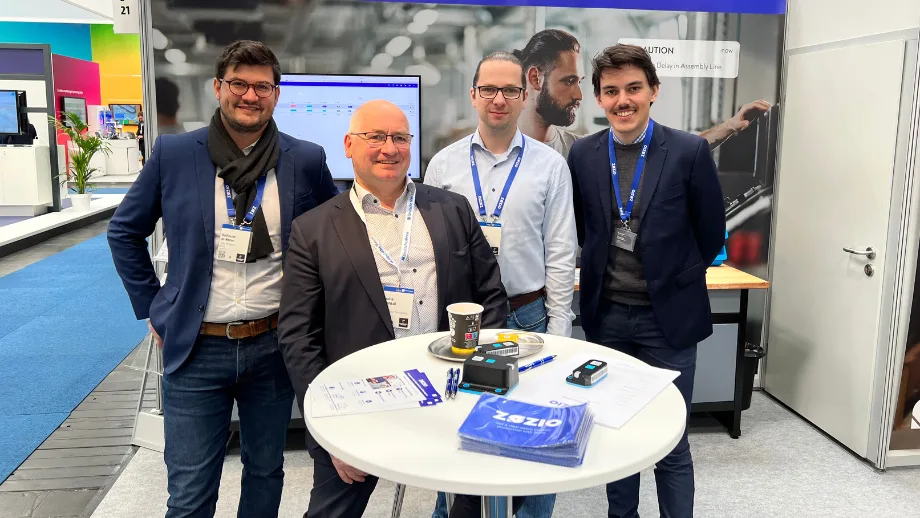
Hannover Messe 2023: Looking Back on a Successful Debut for Zozio
A Guided Tour of Hannover Messe 2023 with Zozio Hannover Messe – or the Hanover Fair – is the world's leading gathering for international industry ex…