
Use cases · Customer service level
Meet the promised date without resorting to emergency measures
At Nicomatic, a manufacturer of connectors for aerospace, defence, medical and industrial applications, meeting lead times is one of the key commitments to customers.
- Industry — Connectors & interconnection
- Scope — 2 sites in France + group-wide replication
- Modules — Tracking · Workflow Control · Scheduling
- In production since 2022

Customer background
OTD as a commercial promise, in a job shop.
It is the hardest thing to hold in a job shop: a wide variety of routings, non-linear flows, mini-factories with different optimisation models, a growing load. A delay at one workstation propagates in a non-intuitive way.
The industrial context at the French sites
Parameter | Value |
|---|---|
French production sites | 2 sites, one of them with an extension |
Mini-factories within the group scope | 5 + mini-factories — components, assembly, custom |
Optimisation models | distinct for each mini-factory — a group standard to be built |
Effective capacity assumed per operator | 6 h 30 |
Systems in place | |
Flow zones tracked per shop floor | 5 zones — preparation, inspection, assembly, WIP / waiting, WIP bis |
Day-to-day before ROBIN
The slightest delay created an absolute emergency.
- No real-time visibility of the launches in progress on the shop floor
- Inefficient supply of tools and components — what is missing is discovered at the workstation
- Imprecise process and operation times: standard hours no longer reflect reality
- No way of knowing which launch is late before it is delivered late
- No way to prioritise jointly across the mini-factories
- Load expected to grow sharply over the coming years
The Zozio solution
Make the delay visible before it happens.
The starting point: physically tracking the launch bins on the shop floor, through zone geolocation. Each bin carries a tag, each zone is instrumented — crossing into a zone automatically triggers the stage change in ROBIN.
Building block 1 — Data model
The promised date and the physical position in the same object
The data model is the heart of the system. Each launch carries both the business fields coming from the PPS and the fields coming from the geolocation platform.
- PPS fields: item, phase, operation, workstation, manager code, customer, quantity, production end date, “to be delivered on” date
- Geolocation fields: zone entry date, exit date, zone, stage
- Plus the priority and the person in charge
Building block 2 — Thresholds & alerts
Turn dwell time into an alert
The second step, and the one that changes the service level: define dwell-time thresholds per stage, and alert automatically before they are exceeded.
- Thresholds are calculated in working hours only — no false alerts on Monday morning
- The weekend is handled explicitly: counters stop on Friday at 4 pm and resume on Monday at 7 am
- Stage changes are produced by automatic rules triggered by geolocation, not by manual entry
Building block 3 — Prioritisation
Prioritise, and make the priority visible
The service level is decided by the trade-offs. ROBIN carries a 4-level priority system (P0 to P3), used across the operational views.
- Urgent launches board, filtered on the highest priority
- Alert when the production end date is exceeded, with the person in charge
- Breakdown of launches by priority, overall and by waiting zone
- Shop floor map: position, priority, stage and missing components
- Full history per launch — the basis for challenging standard hours
Building block 4 — Scheduling
Schedule to meet the date, not to fill the machines
ROBIN was integrated as the scheduling module of the MES being rolled out, with a standard application model that can be replicated site by site. The project was built in successive work packages.
- Work package 0 — data model and PPS → ROBIN interconnection
- Work package 1 — manual scheduling, extended to all mini-factories
- Work package 2 — automatic scheduling on the priority mini-factories
- Work packages 3-4 — all scopes, then group-wide replication and multi-site smoothing
Dwell-time thresholds per stage
Flow stage | Threshold | Alert |
|---|---|---|
Preparation | > 24 h | Alerted launch |
Inspection | > 24 h | Alerted launch |
In progress / on hold | > 48 h | Alerted launch |
In progress (2) | > 48 h | Alerted launch |
The tracking system deployed
Site | Tags | Anchors | Gateway |
|---|---|---|---|
Main site (assembly shop floor) | 50 | 10 | 1 |
Second-site extension | 30 | 15 | 1 |
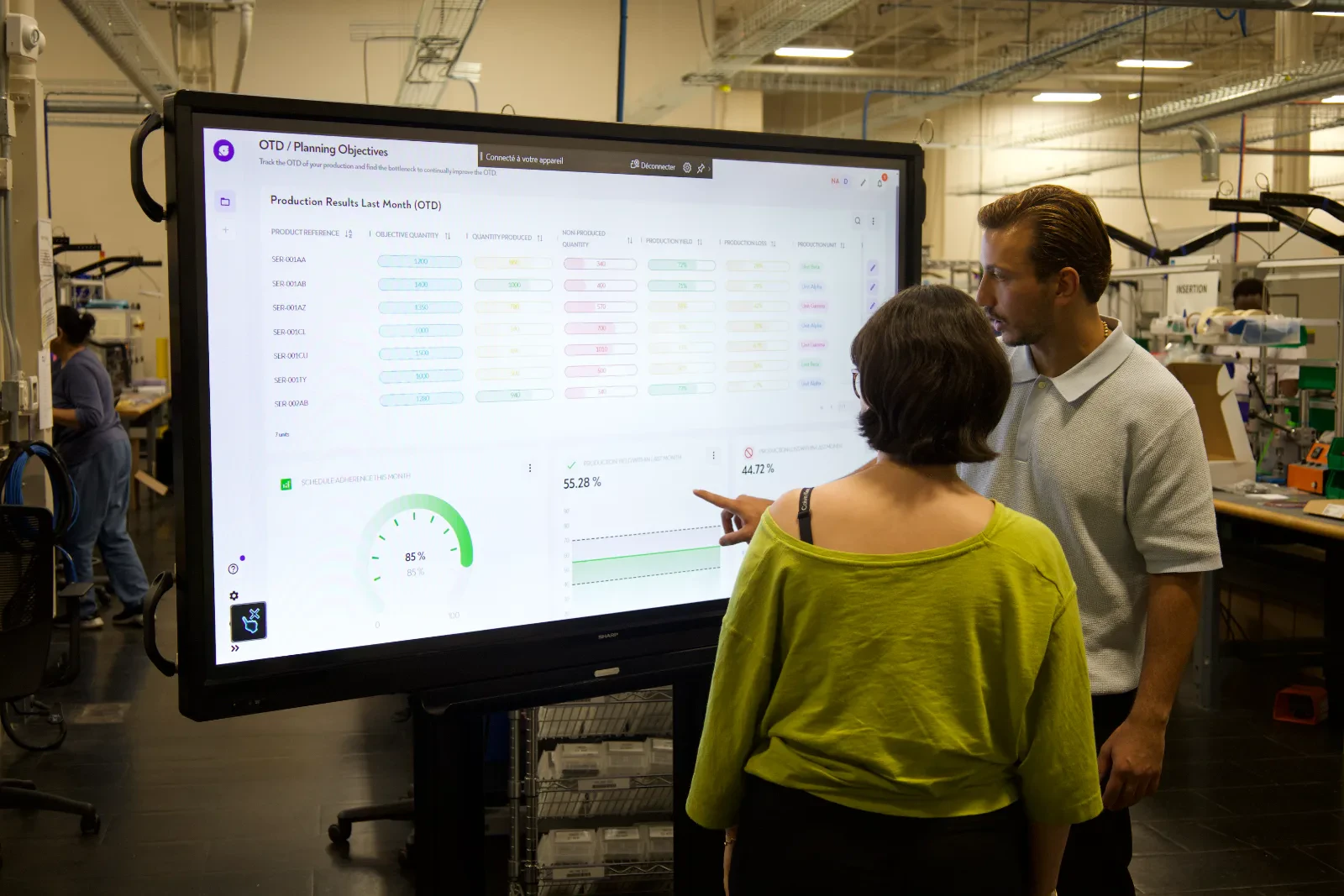
Implementation on the ground
Usage before sophistication.
The deployment followed the ROBIN.Deploy method. One project trade-off is worth highlighting, because it is counter-intuitive and it proved to be the right one.
Data model first
Building the data model and the ERP → ROBIN API interconnection. It is this cross-reference — the date promised to the customer and the physical position of the launch in the same object — that makes the service level manageable.
Batch 0Manual scheduling everywhere, before automating
The scope was deliberately refocused to roll out manual scheduling across all component mini-factories and pre-assembled / custom lines, before automating. Priority goes to usage and the data standard, rather than to algorithm sophistication on a single scope.
Batch 1 — deliberate refocusAutomation, then group-wide replication
Automatic scheduling on the priority mini-factories, extension to all scopes, then group-wide replication and multi-site load levelling.
Batches 2 to 4
At the group's North American site
The connected electronic tag puts the priority on the object.
A priority that is not visible on the object is not applied. The group's North American site went further with the deployment of geolocated connected electronic tags (BLE-ESL display tags).
The ESL system deployed
System element | Volume |
|---|---|
Connected electronic tags (display tags) | 180 |
High-precision geolocation locators | 29 |
Gateways | 2 |
- Up-to-date data on the paperless work order — no more outdated job traveller
- Priorities and sequence changes decided by scheduling, communicated directly on the object
- High-precision geolocation: searching for a work order on the shop floor becomes unnecessary
- Measurement of actual routine durations, to challenge standard hours
- Combined with a large shop-floor screen, it makes WIP visible to everyone in real time
The targets set for this deployment: OTD ≥ 95 % despite the load growth expected over 3 years, and a zero-paper digital factory with a target of 1 day saved per work order by removing non-value-adding steps.
Measured results
Duration, the first indicator of success.
WIP tracking with geolocation has been in continuous production since 2022 at the French sites, with a renewed subscription — and a scope extension at every cycle.
- 2022in continuous production since, subscription renewed and scope extended at every cycle
- ≥ 95 %OTD targeted on the North American deployment — a target contractually committed in the project
- 1 daysaved per work order, target of removing non-value-adding steps
- 7scopes deployed — launches, tooling, semi-finished parts, subcontracting, non-conformances, scheduling, API
The scope covered today: launch tracking (tracking and geolocation of bins by zone) · tooling tracking (geolocation and traceability of the fleet) · semi-finished parts tracking · subcontracting management · non-conformance management (shop-floor reporting and root-cause analysis) · multi-mini-factory WO scheduling · ERP ↔ ROBIN API interconnection.
Service level levers
Orders of magnitude modelled, not yet measured here.
These orders of magnitude were modelled by Zozio on the basis of a comparable manufacturer. They do not come from measurements taken on this project.
Lever | Order of magnitude |
|---|---|
OTD gain through dynamic prioritisation and real-time visibility | +15 OTD points |
Lead time reduction through automatic re-planning | −20 % |
Reduction in supervisors' manual re-planning | −80 % |
Group capacity gain through multi-site levelling | +5 % |
Scheduling recalculation time when a disruption | occurs: under 3 seconds |
Before you get started
What this project required, in practice.
The four questions every industrial management team asks before signing, and the answers as they were verified on this project.
In batches, no big bang
Batch 0 for the data model, batch 1 for manual scheduling everywhere, then automation. Every batch is usable in production.
Your rules, not ours
Thresholds per step in working hours, counters stopped at weekends, priorities P0 to P3: the rules are those of the shop floor, configurable without development.
Replicable across the group
A standard application model, deployed site by site, up to multi-site load levelling. Hosting in France, Europe or the USA.
Go further
Related use cases.

Aviation MRO
Reduce TAT
TAT is not lost in working time, but in the queues nobody measures.

Electronics
Real-time WIP visibility
Scanning gives progress, geolocation gives position. It is the combination that eliminates searching.

Animal health
Moving beyond the Excel schedule
Excel is not the problem, it is the symptom. Shop-floor data first, then the schedule.
Frequently asked questions
Service level and OTD.
What is the service level in production?
The service level — or OTD, On-Time Delivery — is the percentage of orders delivered within contractual lead times. It is the indicator that measures how well customer commitments are met, and in many specialist industries, an element of the commercial value proposition, not merely an internal KPI.
Why is service level difficult to maintain in a job shop?
Because flows are not linear: a wide variety of routings, multiple passes on the same resources, and cascading queues. A delay at one workstation propagates in a non-intuitive way. Without real-time visibility into the position and dwell time of WIP, delays are only detected at delivery.
How to improve your service level in practice?
Three steps, in this order. Measure: track WIP and geolocate its position, automatically timestamping every zone change. Alert: define dwell-time thresholds per stage, in working hours, and alert before they are exceeded. Prioritise: implement a shared priority system and make priority visible on the item — shop floor screen or connected electronic label.
What role does geolocation play in improving service level?
It eliminates manual entry and therefore lag. When geolocation automatically triggers a stage change, dwell time is measured without human intervention — and the delay alert fires at the right moment. It also allows standard hours to be challenged against actual observed durations, which makes promised dates more reliable.
How does the connected electronic label improve service level?
Because a priority that is not visible on the part is not applied. The label displays up-to-date work order data, communicates priority changes decided by scheduling, and remains geolocated in real time. It replaces the paper traveller — with, on the group's North American deployment, a target of 1 day gained per work order.
Should scheduling be automated from the outset?
Not necessarily, and this project's experience demonstrates as much. The scope was refocused to deploy manual scheduling across all mini-plants before automating — priority given to adoption and data standards. A sophisticated algorithm on an isolated scope delivers lower service levels than a simple tool used everywhere.
Should we replace our ERP?
No. Your ERP remains the system of record for work orders, routings and bills of materials: it was designed for management, not for detailed scheduling. ROBIN connects to it through standard connectors (SAP, Sage and others) and takes over what it cannot do: dynamic finite-capacity scheduling and real-time shop-floor data (tracking, geolocation, actual progress).
The same goes for an existing MRO system: ROBIN pulls its work orders, routings and standard hours, and adds the layer it lacks. Your ERP investment is preserved.
Take action
Is your service level managed or merely observed?
Let's take stock of your shop floor.
30 minutes on your data · Reply within 24 h · No commitment