
Industries · Cosmetics & Pharma
A missing vessel holds up the entire campaign.
Batch processing, mandatory cleans between product families, a fleet of mobile containers shared across shop floors. The constraint is not blending capacity — it is the sequencing, and the actual state of the fleet at the moment of launch.


Who it's for
Cosmetics, dermo-cosmetics and pharmaceutical manufacturing and packaging sites: weighing, manufacturing, filling, packaging. A fleet of tanks and mobile containers shared across shop floors or across sites.
What ROBIN does
Campaign sequencing that factors in cleaning, product compatibility and maturation times; geolocation of the mobile fleet with compliance checks; timestamped traceability of every movement.
What it changes
Fewer unnecessary cleanings, less time spent looking for a container, and proof of execution available at audit time without manual reconstruction.
Industry challenges
The cost is not in manufacturing. It is in what comes before it.
Weighing and mixing take a few hours. Cleaning, qualifying, finding the right tank and proving compliance often take longer. Between manufacturing, packaging and washing, it is the waiting that sets the pace.
Productivity · OEE
OEE is lost between operations, not during them.
Format changeovers, waiting for a clean tank, waiting for a released order, micro-stops on the line: actual productive time is often well below opening time. Without measurement at the workstation, the gap stays invisible and is addressed with overtime rather than with sequencing.
Pull flows · WIP
The buffer stock between the three shop floors absorbs the disorder — and pays for it.
Bulk waiting for a free packaging line, tanks waiting to be washed, packaged batches waiting for release. Every buffer ties up material, containers and floor space. Add to that the subcontracted operations — contract packaging, decoration, external inspection — whose return lead times remain unclear: bulk and containers sent to a provider drop off the radar and inflate a WIP that nobody manages. Synchronising manufacturing, packaging, washing and subcontracting in a pull flow brings that WIP down without investing in capacity.
Remnant management
Bulk left over at the end of a campaign expires because it is not rescheduled.
Tank heels, surplus bulk, opened raw materials: these remnants have a use-by date and occupy containers. Without visibility on their quantity, location and expiry, they are rediscovered too late and end up destroyed rather than used in the next campaign.
Tank fleet
Your mobile containers are a critical resource that nobody plans.
Limited numbers, washing, drying and requalification cycles, moves between buildings or between sites. A tank that cannot be found or is non-compliant blocks a launch — and the information only surfaces when the shop floor needs it.
What ROBIN brings
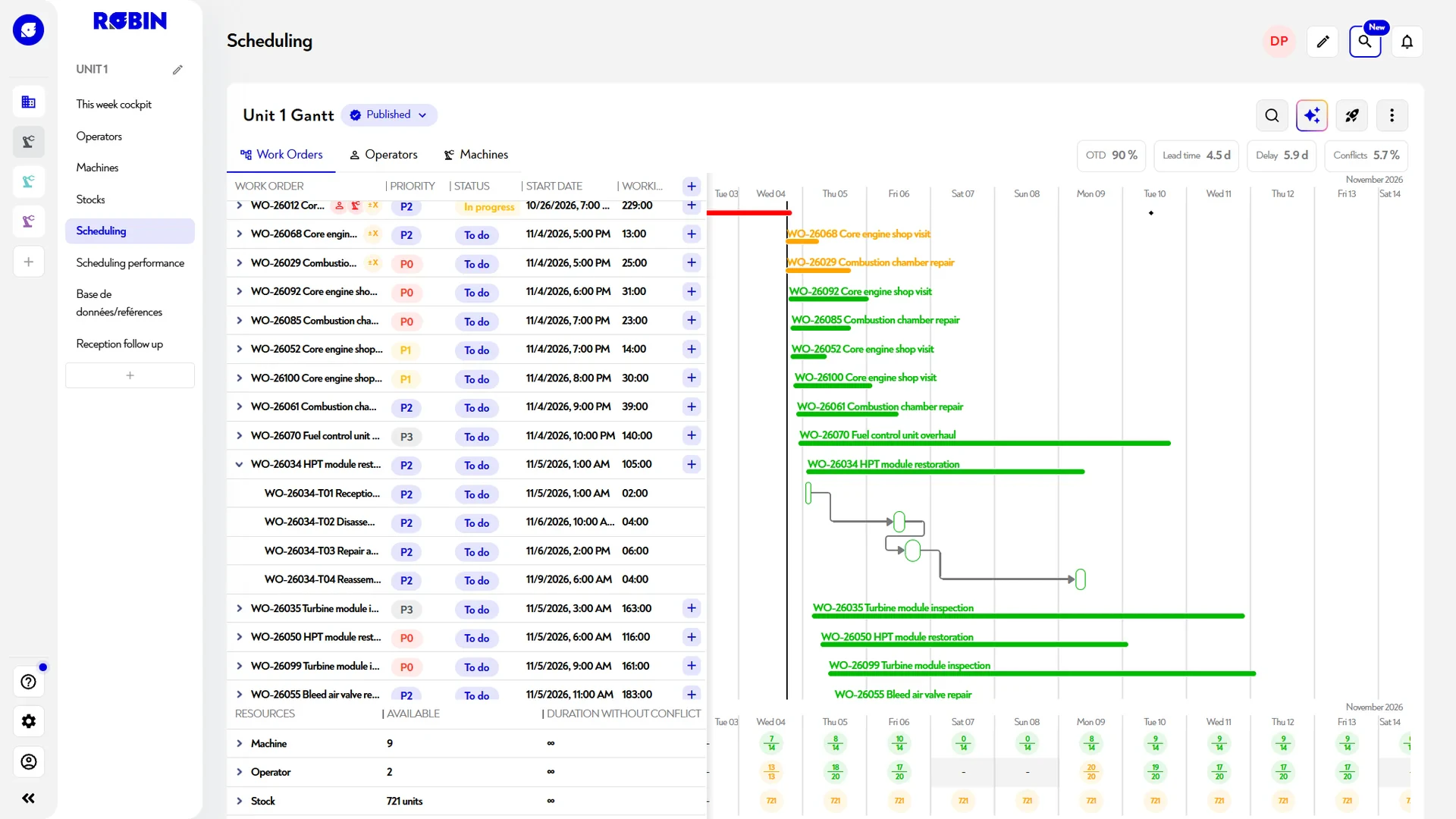
Campaigns sequenced on real constraints, not on an average.
Facing remnants
Use up the remaining bulk before it expires.
ROBIN knows the available bulk quantities, the container holding them and their use-by date. The scheduler proposes them first for compatible campaigns, and raises an alert when a deadline approaches with no planned use.
- Remnants linked to their container and use-by date
- Priority allocation to compatible campaigns
- Alert before expiry, not after
Facing the tank fleet
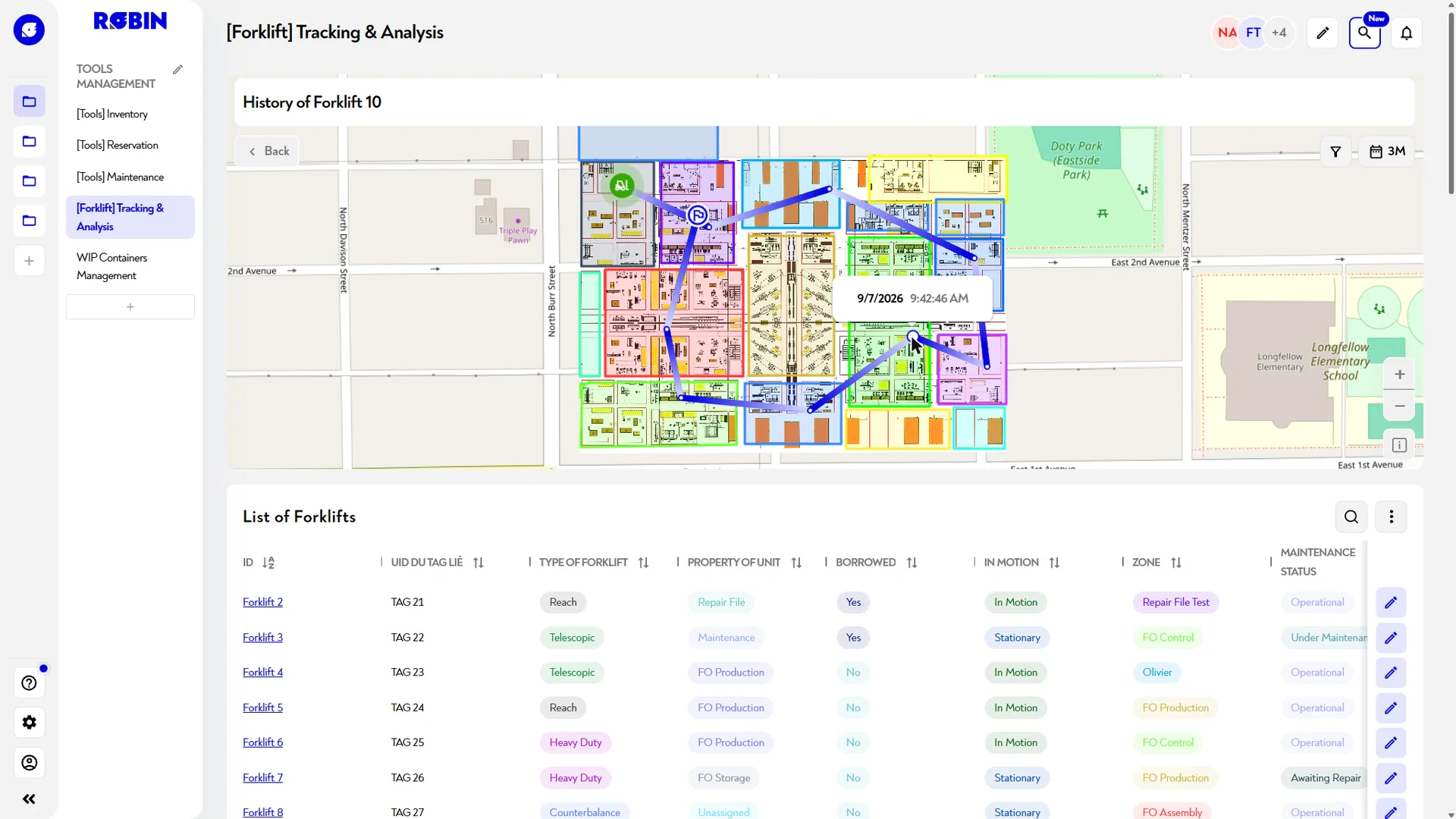
Every container located, its status known, its compliance verifiable.
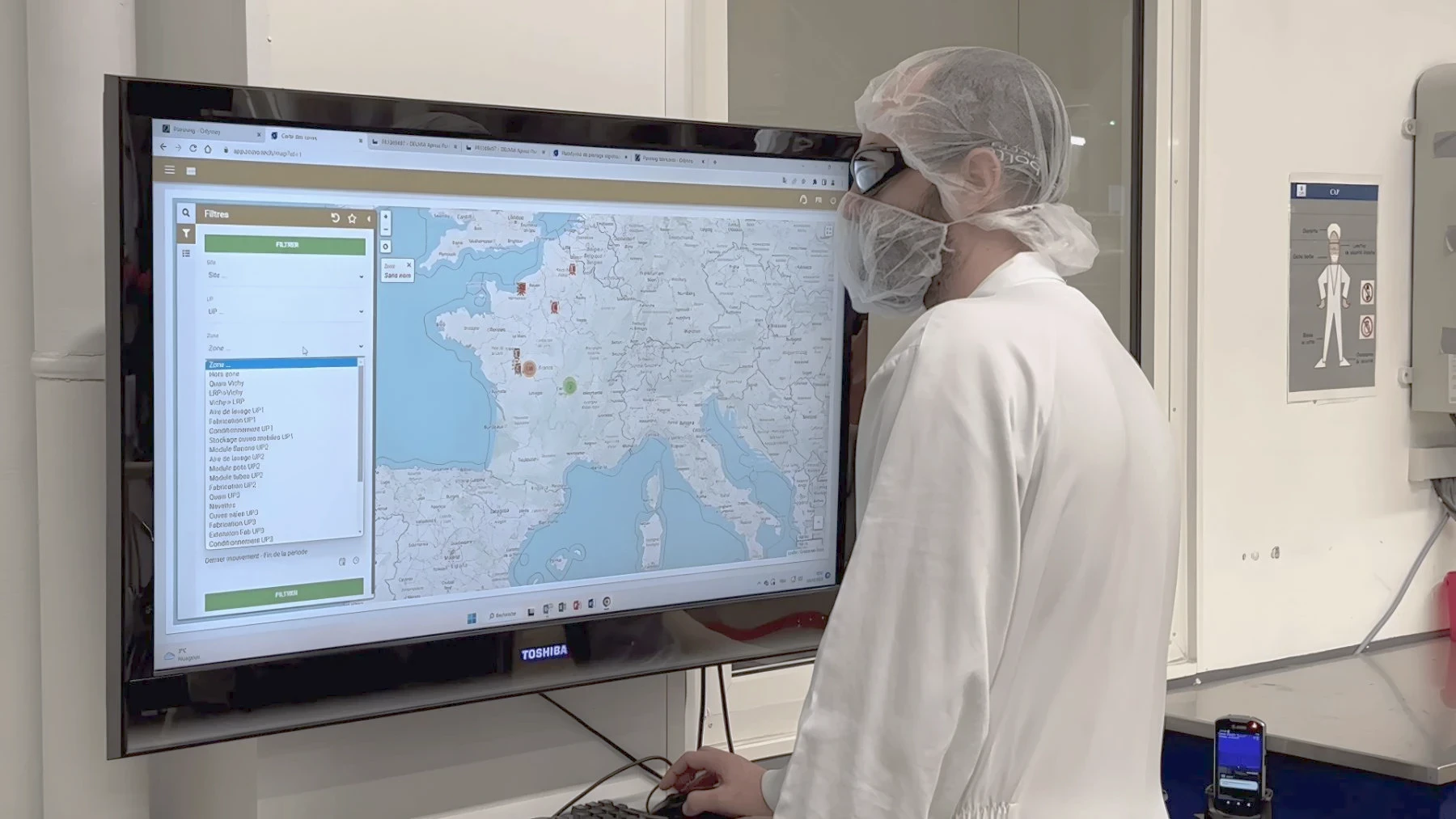
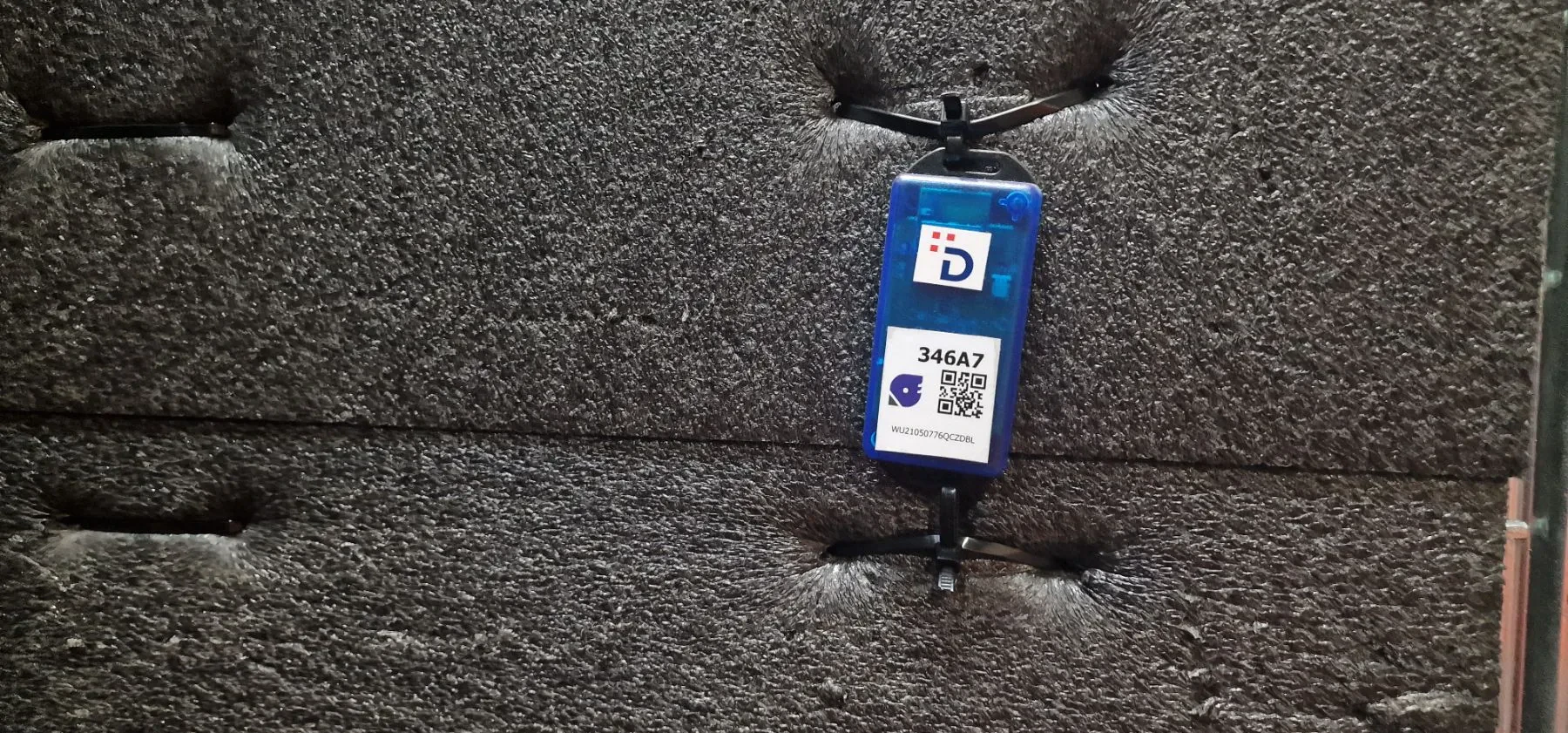
Indoor and outdoor geolocation tracks tanks, bins and trolleys continuously, including during transfers between sites and round trips to a subcontractor. Teams find equipment instead of searching for it, WIP sent outside stays visible with its expected return date, and real availability feeds into the scheduling calculation.
- Real-time position and status, with no data entry
- Compliance and washing cycle tracked per container
- Subcontracted WIP tracked and rescheduled on return
- Less mental load for manufacturing teams
Facing regulatory requirements
Traceability is built during execution.
Every container movement, every operation and every rescheduling decision is timestamped. The complete history remains available to view and export — reconstructing a batch no longer means digging through binders.
- Timestamped history per batch and per container
- Export and consultation without manual reconstruction
- Connected to your ERP and your MES
Facing mobile containers and skids
The tank fleet becomes a planned resource, not a constraint you endure.
ROBIN schedules the container's complete loop: filling, maturation, decanting, washing, drying, requalification, return to availability. Tanks and skids are treated as finite-capacity resources, just like a machine. The plan ensures that a clean, compliant container is available at launch, and triggers decanting early enough to free the container before it runs short.
- Tanks and skids modelled as finite-capacity resources
- Washing · drying · requalification loop built into the schedule
- Decanting prioritised on actual container demand
- Bulk storage capacity preserved, stoppages due to unavailability avoided
Facing priority trade-offs
Prioritise work orders on their value, not on their arrival date.
ROBIN factors the margin, revenue and customer commitment of each order into the priority calculation. When capacity frees up or a disruption forces a trade-off, the plan chosen is the one that protects the service level on the orders that matter most — and the shop floor sees the sequence to execute, not a list to sort.
- Margin, revenue and customer commitment weighted per order
- Automatic trade-off in the event of a disruption or freed capacity
- Prioritised sequence pushed straight to the workstation
- Impact of each decision on the service level quantified before validation
They manufacture in cosmetics

Our story with Zozio was born from a need: to geolocate and track our tank fleet. Today, the application covers 4 roles — production assistant, washer, technician, and manufacturer. Zozio means time saved at work and less mental load. It also delivers a general efficiency gain, whether for operators or for Cosmetic Active Production.
 Cosmetic Active ProductionAll testimonials

Head of Perfume & Fragrance Compound Manufacturing Laboratory, LVMH Fragrance Brands
Stéphane Dubus
Zozio has enabled us to significantly digitalise and automate the management of our mobile tanks. It is a real-time, collaborative platform: we know where the tanks are — including when they are on trucks in transit — while being certain of their regulatory compliance. Working conditions improve significantly, since we reduce the teams' mental load.
- Fragrance Brands · Perfumes

Tracking a tank fleet at L'Oréal CAP
Faustine Liabastre looks back on the deployment of ROBIN at the Cosmetic Active Production site: tank geolocation, four trades covered, lighter mental load.
Watch the interview
Use cases
What cosmetics and pharma sites come looking for.
Three situations that regulated shop floors entrust to us most often, and how ROBIN handles them.

Customer service level
Campaigns and batches delivered on the promised dates, despite format changes and cleaning times between runs.
See the use caseWIP visibility
Every batch located and time-stamped, from weighing to packaging. The history can be viewed and exported without manual reconstruction.
See the use caseManaging disruptions
Longer quality control, equipment unavailable, batch on hold: the plan readjusts while respecting qualification constraints.
See the use case
FAQ · Cosmetics & Pharma
Questions from cosmetics and pharmaceutical sites
Is ROBIN compatible with our GMP requirements and audits?
Yes. Every operation, every container movement, and every rescheduling action is time-stamped and retained. The history is searchable and exportable, making it possible to reconstruct a batch without manual investigation. ROBIN complements your quality system — it does not replace it.
How does ROBIN manage cleaning times between products?
Cleaning operations are modelled as sequence constraints: depending on the outgoing and incoming product, ROBIN automatically inserts the required duration and type of cleaning, and finds the sequencing order that minimises their number without ever violating a compatibility rule.
Can parts and resources be tracked across several buildings or sites?
Yes. Indoor and outdoor technologies are combined, so a work order, container, tank or tool can be tracked on the shop floor as well as during a road transfer between sites. Position, condition and compliance remain visible at all times.
Our curing and stoving times are long and variable — can ROBIN model them?
Yes. These durations are handled as time constraints between operations, with minimum and maximum bounds. ROBIN respects them during sequencing and flags any cases where a waiting period risks exceeding the permitted limit.
Are your IoT sensors ATEX / IECEx certified for our explosion-risk zones?
Yes, for zones that require it. The Zozio hardware catalogue includes ATEX- and IECEx-certified tags and beacons, suitable for gas and vapour atmospheres — alcohols, solvents, fragrances — as well as the dusty atmospheres of weighing zones. Selection is based on your zoning plan: certified hardware is deployed where the zone demands it, standard hardware elsewhere. Certificates and compliance data sheets are provided in the installation dossier.
Take action
Are your campaigns still built by hand?
Let's talk about your shop floor — a demonstration on your data is possible within a few days.