
Role · General Management
You run the business on numbers. What are you running the shop floor on?
ROBIN is Zozio's real-time cockpit for complex-flow shop floors: lead time (TAT), on-time delivery (OTD) and consolidated WIP, site by site, updated at every production event. Your ERP tells you what should be happening; ROBIN shows you what is happening, and lets you intervene before the drift reaches the customer.
They already run their shop floor on ROBIN






The three figures
Three key indicators to run your shop floor day to day.
These are the ones ROBIN consolidates, and the ones that recur throughout this page.
TATTurnaround Time
Lead time
The time between a work order entering the shop floor and leaving it. Every day of TAT is a day of tied-up capital.
OTDOn-Time Delivery
On-time delivery
The share of orders delivered on the promised date. It is what the customer sees, and what triggers penalties.
WIPWIP
Value committed on the shop floor
Parts launched and not yet delivered. It is your working capital requirement, sitting on workbenches.
Your challenges
Scheduling software, seen from the P&L.
Three topics come up at every executive committee, whatever the shop floor: job shop, short runs, one-off parts or maintenance.
Cash tied up on the shop floor
Drifting TAT, OTD penalties, swelling WIP: every day of delay ties up capital. The gain comes not from higher rates, but from the dead time between operations that nobody sees without a global view.
Answer — ROBIN.Cockpit
- Lead time (TAT)−7 %
- WIP€2.4M
- Service (OTD)94,2 %
The capital tied up on the shop floor, readable as a single figure per site, updated with every production event.
Deciding without visibility
The ERP tells you what should happen, not what is happening. Accepting an order, prioritising a customer, adding a shift: these calls are made on stale data or on shop-floor experience.
Answer — ROBIN.Cockpit
- Machine breakdown — Machining line M2Load +18%
- Urgent order accepted — customer ARescheduled
Every event that affects the schedule, with its quantified impact, visible the moment it occurs — not at the monthly committee.
The IT project risk
Legacy APS take 16 to 24 months to deploy, with uncertain shop-floor adoption. The real risk is not choosing a tool: it is tying up your teams in a project that never delivers.
Answer — ROBIN.Deploy
< 3 months- Diagnostic
- Pilot in production
- Extension
A dedicated project manager tracks progress like any other managed project — not a two-year tunnel.
The product
ROBIN, the platform that runs the shop floor in real time.
ROBIN has five modules. From head office, the one that matters day to day is the cockpit: the consolidated view on which you make your calls.
ROBIN.Cockpit
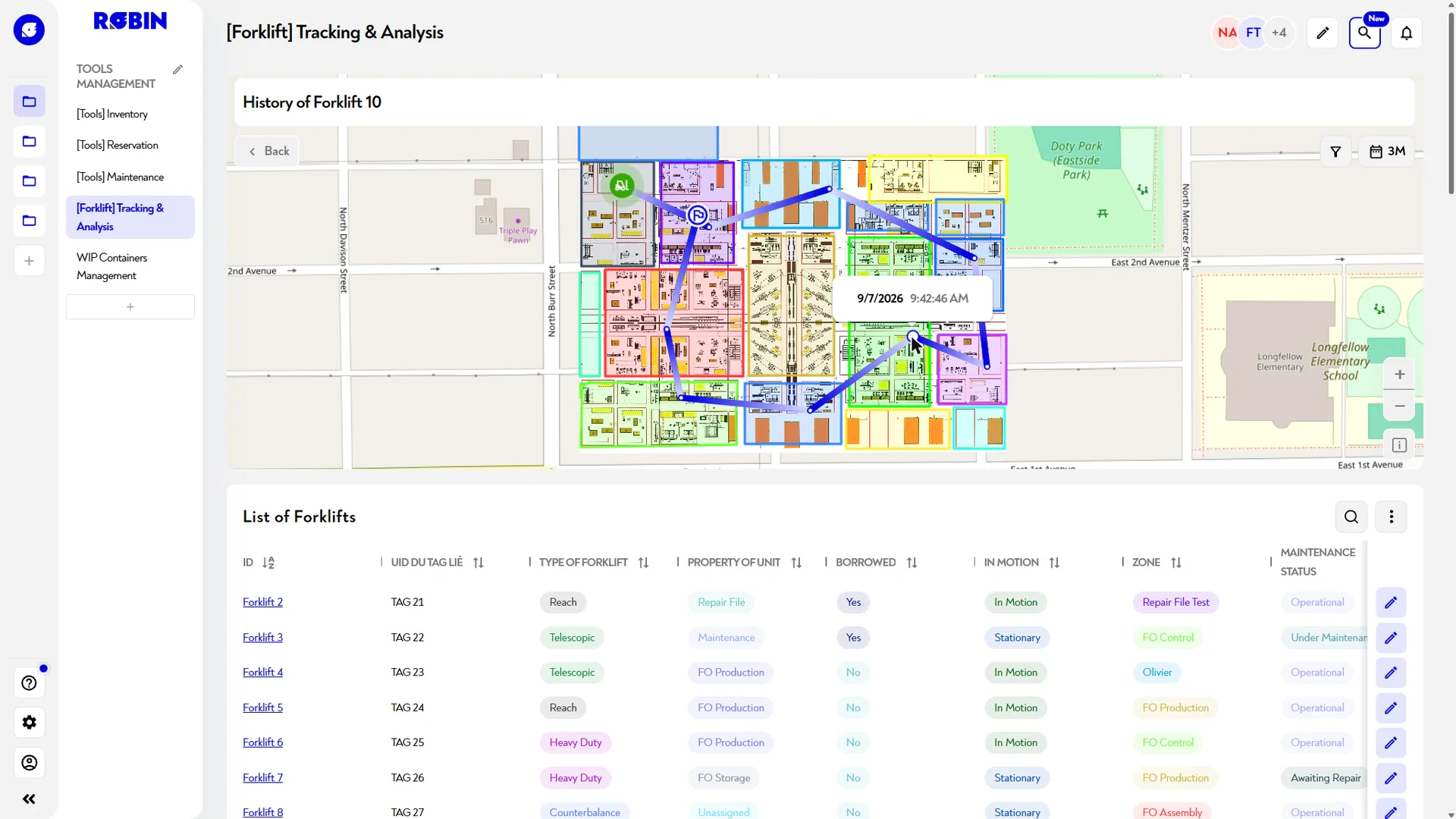
The whole shop floor, visible in one place.
The real-time shop floor dashboard: KPIs, Gantt and alerts, updated with every production event.
- OTD, TAT and WIP consolidated, site by site
- Alerts before the drift reaches the customer
- Zero user limits: the whole shop floor has access
Ask the question, get the figure.
ROBIN.Copilot queries shop-floor data in natural language. Choose a question below: the month's service level, late work orders and their cause, the effect of switching to urgent.
Agentic Copilot
Your scheduling copilot.
Robin Copilot
● online · acts on the schedule
Generate this week's progress report.
Report ready: 128 WOs tracked, 91 completed, 8 late, service level 96.4%. Generated in 2.0 s.
Progress report — W24
Robin · liveThe calculation
What a 7% TAT reduction is worth to you.
An aeronautical repair shop floor cut its lead time by 7% with ROBIN. The mechanism is the same on any complex-flow shop floor — job shop, short runs, one-off parts: less waiting between operations, as much capital freed. Apply the figure to your own scope.
Your scope
Assumption: −7% lead time on a constant scope, average WIP estimated using Little's law (WOs/year × TAT ÷ 365 × unit value). Order of magnitude — the real baseline is set at the diagnostic, on your data.
Investment
What you commit to, stated plainly.
- Annual subscription per site, depending on the modules enabled
- No per-user cost: the whole shop floor has access to the data
- Documented indicative estimate, then a business case built on your data
- Pilot scope in under 3 months, then extension
What ROBIN changes
An investment you manage like everything else.
A quantified ROI before you decide
ROBIN.Deploy builds the business case on your data: expected gains on TAT, productivity, OTD and WIP. Built-in metrics track the value after go-live.
Time-to-value in months, not years
Go-live in under 3 months on a pilot scope, then extension at your teams' pace. No big bang: ROBIN co-pilots your ERP without replacing it.
The results
What it delivers on a real shop floor.
The gains observed on a defined scope, and the customer case that documents them.
- −7%lead time — observed on an aircraft repair shop floor
- < 3 monthsfrom signature to production — vs 16 to 24 months for a conventional APS
- 1 dayof lead time gained = one day of WIP freed on every work order on the shop floor
- 0user limit — the whole shop floor has access to the data, with no per-seat surcharge
Customer case · Aircraft repair shop
Landing gear: 7% TAT gained without adding capacity.
A European MRO absorbs its disruptions without TAT drift: scheduling recalculated in under two minutes, WIP located, no more replanning in Excel.
Read the customer case- −7 %TAT on the equipment tracked
- < 2 minto replan after a disruption
- 0replanning in Excel
They already run their shop floor on ROBIN
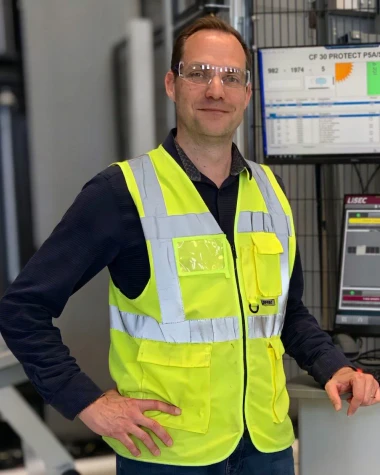
Zozio was the simplest solution to implement, and the most flexible. It enabled us in particular to increase the productivity of our main production line — which also means avoiding the need for additional teams at weekends during production peaks.

The vendor
What you check before choosing a vendor.
Your data stays under your control
European cloud hosting or on your own infrastructure, and export of your data at any time. No irreversible dependency.
Plugged into your IT systems
ROBIN connects to what you already have and replaces nothing.
- SAP
- Sage
- MES
- CMMS
No per-user cost
The budget doesn't depend on the number of people connected. Extending use to the whole shop floor doesn't trigger a renegotiation.
A single point of contact
A ROBIN.Deploy project manager leads the deployment, training and indicator tracking until your teams are autonomous.
Further reading
What we write for executive management.

Dynamic scheduling · Thesis
MRO scheduling: why static scheduling drags down your TAT
It isn't variability that degrades TAT — it's the tool that pretends it doesn't exist.

Customer case · Aerospace
Reducing TAT on a landing gear shop floor
The project in detail: baseline, scope, measured results and deployment timeline.
FAQ · Executive management
The questions we get asked in executive committee
How much does it cost, and how is the investment structured?
The subscription is annual, calculated per site and according to the modules activated (scheduling, simulation, operations management, geolocation…), with no per-user cost. We start from a pricing grid that is as standard as possible, provide an indicative quote within 5 days, then a business case costed on your data before any commitment.
How is return on investment measured?
What is the project risk? What happens if the shop floor doesn't buy in?
The approach is incremental: a pilot scope in under 3 months, value demonstrated, then rollout. Change management is part of ROBIN.Deploy — training, on-site support, and a dedicated project manager until you're self-sufficient. No 2-year tunnel.
Should we replace our ERP?
No. Your ERP remains the system of record for work orders, routings and bills of materials: it was designed for management, not for detailed scheduling. ROBIN connects to it through standard connectors (SAP, Sage and others) and takes over what it cannot do: dynamic finite-capacity scheduling and real-time shop-floor data (tracking, geolocation, actual progress).
The same goes for an existing MRO system: ROBIN pulls its work orders, routings and standard hours, and adds the layer it lacks. Your ERP investment is preserved.
Who in my organisation should own this project?
The sponsor is typically the head of manufacturing or the head of operations, with a single point of contact on the Zozio side (ROBIN.Deploy) throughout the project. Senior leadership validates the business case and monitors the KPIs; they do not need to manage the rollout on a day-to-day basis.
Take action
The shop floor can be run on facts.
Our teams work alongside yours to establish the baseline, define the scope and document the expected gains.