
Role · Supply chain / Procurement
You order against a required date that no one can confirm.
ROBIN calculates the required date for each component from the actual shop floor schedule, at finite capacity. When the plan moves, requirements move with it. You procure against a date that holds, instead of absorbing uncertainty with stock.
They already synchronise their flows with ROBIN






The three figures
Three figures are enough to keep procurement on track.
These are the ones ROBIN recalculates at every rescheduling, and the ones that recur throughout the rest of this page.
Needdate
When the material must be there
Calculated on the real sequencing of operations, not on a standard lead time. It is the only date a buyer can commit to.
Shortagesbefore release
What blocks the release of a WO
Components missing at the time of release. Discovered at the workstation, they cost a full rescheduling.
Coveragestock / consumption
What you carry in stock
The stock that compensates for schedule uncertainty. Once the need date becomes reliable, it no longer serves a purpose.
Your challenges
Three things that make procurement impossible to keep on track.
They recur in every complex-flow shop floor: job shop, short runs, one-off parts or maintenance.
Theoretical need dates
The ERP calculates with infinite capacity: it assumes the shop floor can absorb everything. The resulting date matches no real sequencing, and the buyer knows it.
Answer — ROBIN.Scheduling
- ERP requirement12/09
- Real requirement19/09
- Gap7 d
The need date is recalculated at every rescheduling, on the real sequencing of operations.
The shortage discovered at the workstation
The operator opens the file and the part isn't there. The operation is postponed, the workstation sits idle and scheduling has to start over.
Answer — pre-release alert
- OF-8842 — 2 components at riskD−6
- OF-8851 — full coverageReady to release
WOs whose material coverage is at risk are flagged before they reach the workstation, with the time remaining.
Stock to compensate for uncertainty
When the need date isn't reliable, you cover with safety stock. It is tied-up capital compensating for a planning flaw, not a supplier risk.
Answer — synchronised requirements
At every disruption- Shop-floor disruption
- Rescheduling
- Requirements up to date
The schedule and material requirements move together. Safety stock covers supplier risk, no longer planning risk.
The product
ROBIN, the platform that runs the shop floor in real time.
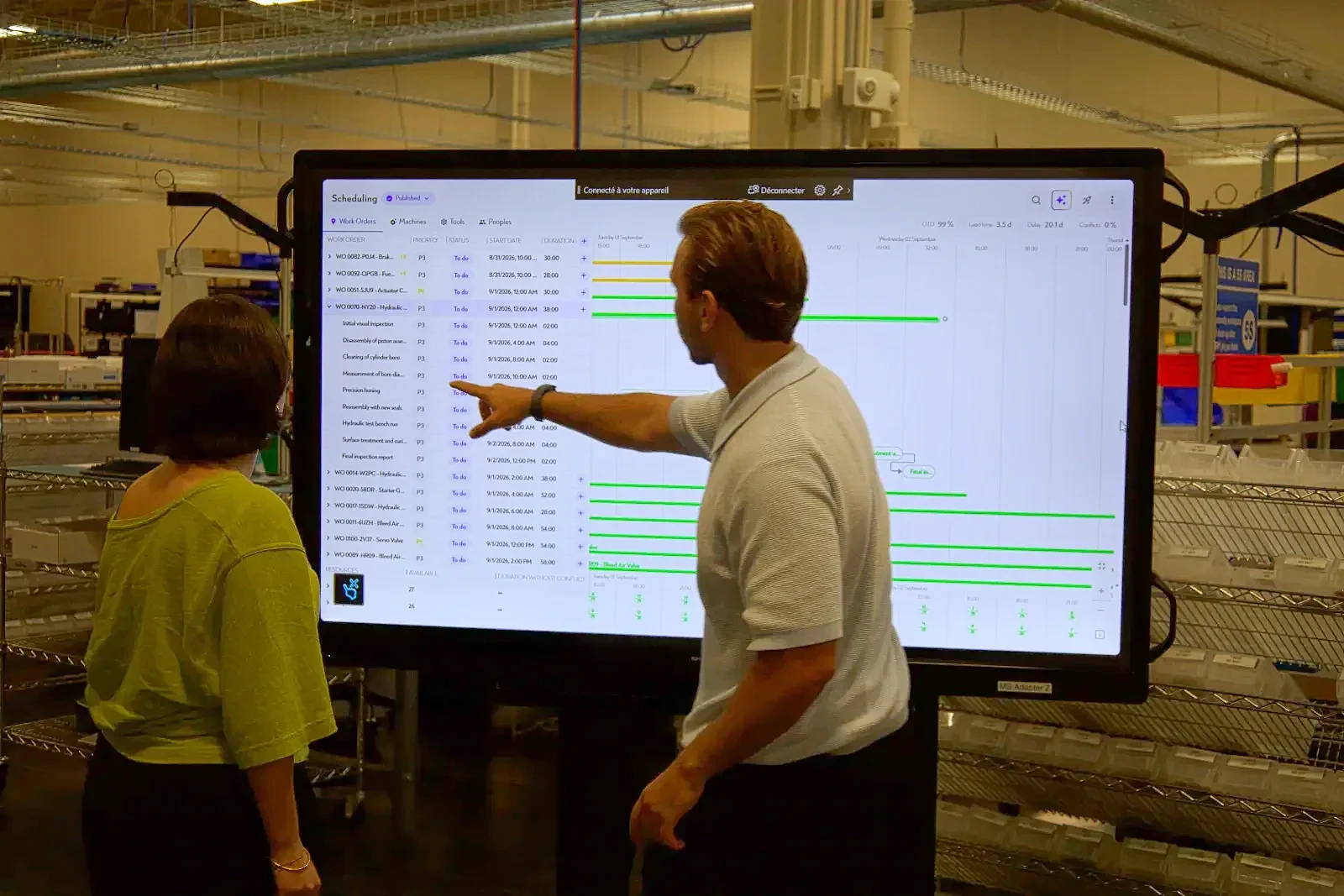
ROBIN has five modules. The one that determines your need dates is the scheduling engine.
ROBIN.Scheduling
Material requirements follow the real schedule.
Finite-capacity scheduling for the shop floor: need dates calculated on the real sequencing, recalculated at every disruption.
- 4,200 operations recalculated in under three seconds, need dates included
- Alert on work orders whose material coverage is at risk
- A single schedule shared by scheduling, production and procurement
The calculation
What uncertainty costs you in stock.
The stock that covers planning risk is tied-up capital, not supplier protection. Making the need date reliable frees up part of it. Enter your orders of magnitude.
Your stock
Assumption: 30% of the stock tied to schedule uncertainty released by making need dates reliable. Order of magnitude — the real baseline is set at the diagnostic, on your data.
Your position
What you keep, and what you let go.
- You keep the cover against supplier risk, which remains real
- You drop the stock that compensated for an uncertain schedule
- You gain the alert: uncovered work orders flagged before the workstation
- A single need date, shared with scheduling and production
What ROBIN changes
Procurement aligns with the real shop floor.
A defensible need date
It comes from the real sequencing of operations, at finite capacity. With a supplier as well as internally, you justify the date instead of negotiating it.
Shortages seen before the workstation
Material coverage for each work order is assessed before release. The shortage becomes an alert at D−6, not a discovery when the file is opened.
Less stock for the same service
Once the schedule stops being uncertain, part of the safety stock no longer serves a purpose. The capital is freed up without degrading the service level.
The results
What this delivers on a real shop floor.
The gains observed on a defined scope, and the customer case that documents them.
- < 3 sto recalculate 4,200 operations and the associated need dates
- < 2 minbetween a declared disruption and up-to-date material requirements
- 94,2%OTD achieved on the monitored scope, measured continuously
- < 3 monthsfrom signature to production on a pilot scope
Customer case · Aircraft repair shop
Landing gear: 7% TAT gained without adding capacity.
A European MRO absorbs its disruptions without TAT drift: scheduling is recalculated in under two minutes, and need dates follow.
Read the customer case- −7 %TAT on the monitored equipment
- < 2 minto reschedule after a disruption
- 0rescheduling in Excel
The vendor
What you check before changing your planning reference.
Your data stays under control
European cloud hosting or on your own infrastructure, and export of your data at any time. No irreversible dependency.
Connected to your IT system
Requirements and orders stay in the ERP. ROBIN calculates the date by which material must be at the workstation.
- SAP
- Sage
- MES
- CMMS
No per-user cost
Giving procurement staff and storekeepers access to the schedule costs nothing extra.
A single point of contact
A ROBIN.Deploy project manager models your constraints and lead times with you, and stays until you are autonomous.
Further reading
What we write for an industrial supply chain.
Dynamic scheduling · Thesis
MRO scheduling: why static scheduling drags down your TAT
It is not variability that degrades TAT — it is the tool that pretends it does not exist.

Customer case · Aerospace
Reducing TAT on a landing gear shop floor
The project in detail: baseline, scope, measured results and deployment timeline.
FAQ · Supply chain
The questions we get asked in procurement reviews
Where does the requirement date calculated by ROBIN come from?
What happens when the schedule changes?
Requirement dates are recalculated alongside it in under two minutes. Procurement immediately sees which requirements have moved forward and which have been pushed back, along with the variance against the original order.
Does ROBIN place orders on our behalf?
No. Orders and contracts remain in the ERP. ROBIN provides the required date and the coverage alert; the purchasing decision stays with you.
How are shortages detected?
The material coverage of each work order is assessed prior to release, based on current stock levels and expected receipts. At-risk WOs are flagged with the time remaining before they reach the workstation.
Can safety stock be reduced without degrading service levels?
The portion covering scheduling uncertainty, yes. The portion covering supplier risk, no — and ROBIN makes no such claim. The diagnostic separates the two before any commitment.
Should we replace our ERP?
No. Your ERP remains the system of record for work orders, routings and bills of materials: it was designed for management, not for detailed scheduling. ROBIN connects to it through standard connectors (SAP, Sage and others) and takes over what it cannot do: dynamic finite-capacity scheduling and real-time shop-floor data (tracking, geolocation, actual progress).
The same goes for an existing MRO system: ROBIN pulls its work orders, routings and standard hours, and adds the layer it lacks. Your ERP investment is preserved.
Take action
A need date you can commit to.
Send us an extract of your work orders and bills of materials: we show you the gap between the theoretical date and the real date.