


How long does your Monday schedule hold? In most MRO shop floors we visit, the honest answer is: 10 a.m.
Monday, 8 a.m. Everything is perfectly planned.
The schedule is on display, priorities are clear, every test bench has its sequence. Then the first disruption hits — a diagnosis heavier than expected, a missing PN, an absence. Nothing serious, nothing out of the ordinary. But the schedule doesn't move: nothing is officially declared, and each small deviation stacks on top of the last.
Expand the scene (+1 min)
By 10 a.m., the technicians have started improvising: one moves to the next bench, the blocked part is set aside "on hold", an operation is pushed back "just a little". Everyone optimises locally, in good faith, with no view of what comes downstream.
Meanwhile, someone tries to bring the Excel file up to date — an hour of work, a few back-and-forths in meetings. And in the MRO director's office, the schedule on display is still the morning one, unchanged. Two parallel realities: the file's, and the hangar's.
How long does your Monday plan hold?
None of these disruptions is exceptional. What costs is the time between when they occur and when the plan is corrected — while the two lines above silently drift apart.
The problem: everyone expects it, nobody has the tool.
MRO variability is normal — it comes from the complexity of the product. The real condition of a part is only known at diagnosis, operating times are uncertain by nature, and routings grow as work progresses. That isn't the problem. The problem is that a static schedule — drawn up in the morning, never recalculated — is structurally unable to keep up. And the time lost between the disruption and the reaction is paid for in TAT.
The disruption doesn't degrade TAT. The delay does.
The promise of dynamic scheduling
The idea isn't to eliminate disruptions — that's impossible. It's to manage them without impacting TAT: a schedule that recalculates when reality changes, simply and quickly, aligned with the real constraints of MRO. No more Excel to redo, no more arbitration meeting at every unforeseen event — priorities propagate on their own all the way to the workstations.
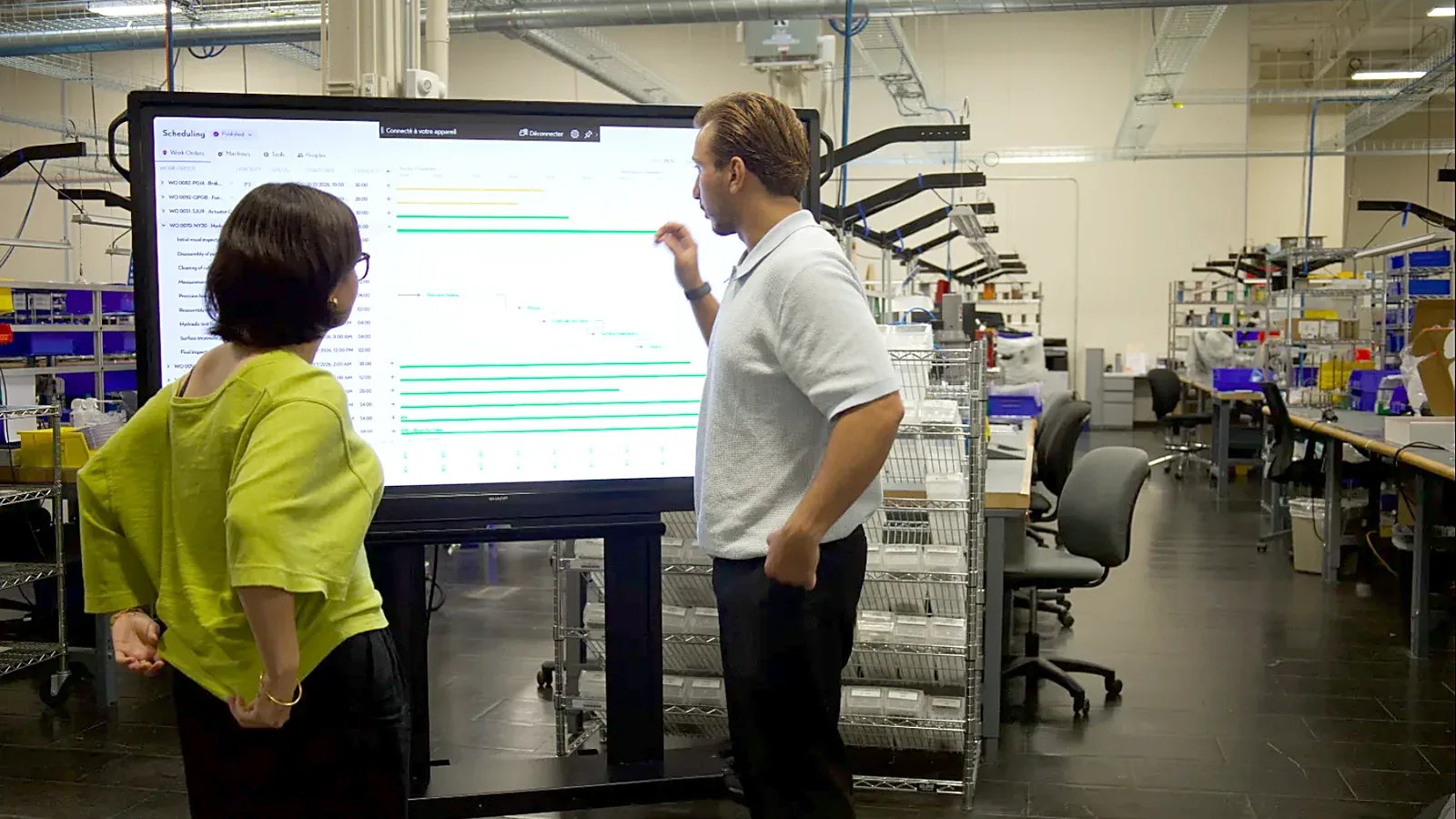
Traditional planning tools assume a stable world. The shop floor never is.
What does waiting really cost?
On projects managed with ROBIN, the observed TAT reduction is around 7%. On a 10-day project, that's 17 hours given back to the customer — without working any faster. The gain comes from eliminated idle time and avoided organisational errors: around 30 minutes saved per day and per operator.
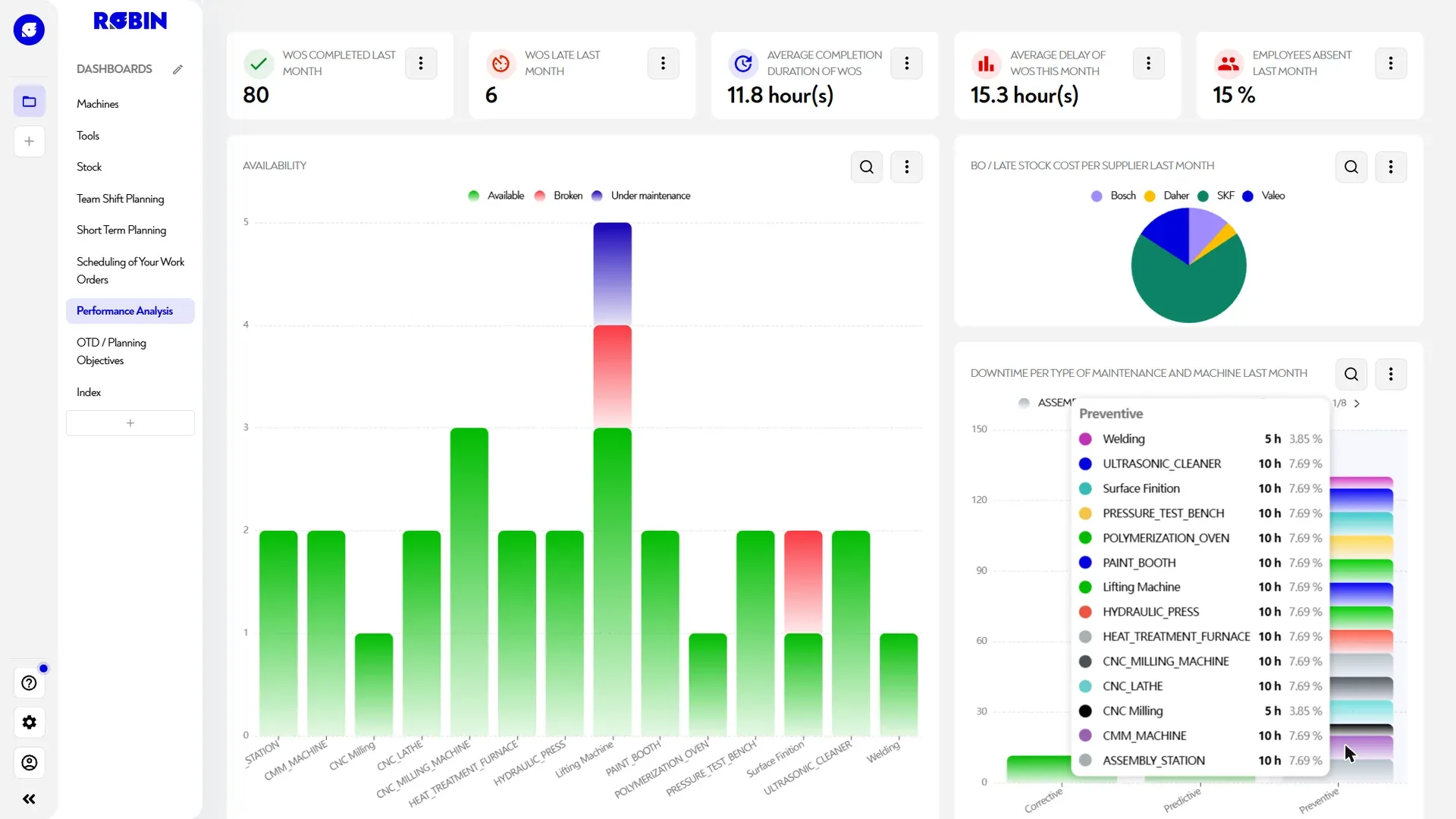
Expand the customer example (+2 min)
At a European MRO provider specialising in landing gear equipment, the before and after speaks for itself. Before: almost every rescheduled task was rescheduled by hand, and a disruption took several hours to be detected and passed on — the time for it to come up, for the Excel file to be redone and for the instructions to go back down.
After: detection takes a few minutes thanks to real-time tracking, re-sequencing is automatic, and the number of reschedulings absorbed without intervention runs into dozens per week — each of which used to cost a manual reorganisation.
Zozio's partnership with Fokker Services, a recognised player in aeronautical MRO, also anchors this approach in the sector's real requirements — traceability included. The full customer case is here.
À retenir
- MRO variability is normal: it comes from the complexity of the work, not from poor organisation.
- Disruptions do not degrade TAT — reaction time does.
- Static scheduling is structurally unsuited to an environment where the routing and the times change mid-job.
- Moving to dynamic scheduling, for every link in the chain, is not about working faster: it is about no longer wasting time needlessly — which cannot be seen without an overall view.
Frequently asked questions
What is the difference between static and dynamic scheduling in MRO?
Static: a schedule set in the morning that does not recalculate when something changes. Dynamic: a schedule that takes the reality of the shop floor into account and adjusts easily, intuitively and quickly — without redoing everything by hand.
Why is TAT so hard to hold in aeronautics or in a job shop?
Because of the variability of the work: the initial schedule is bound to change considerably, with the need to reorganise each time. Without a suitable tool, every reorganisation costs lead time — and lead time adds up to days of TAT.
In practice, how does a dynamic scheduling tool work?
It receives data in real time — people, parts, processes, available resources — and recalculates priorities automatically. No meeting, and no Excel.
Which indicators show whether your MRO scheduling is really effective?
Average TAT per type of work package, the number of manual reschedulings over a given period, and the late-delivery rate. If all three drift together, the problem is the tool, not the teams.
Is an ERP such as SAP enough to schedule an MRO shop?
An ERP manages requirements, stock and invoicing at the level of the day or the week. It does not sequence operations on resources hour by hour, and it does not recalculate when an inspection takes longer. That is the job of an APS, which connects to the ERP rather than replacing it.
Can you do dynamic scheduling in Excel?
Excel can display a schedule, not recalculate it under constraints at every event. As soon as there are several resources, competing priorities and daily disruptions, updating it by hand costs more time than the disruption itself — and the file drifts away from what is happening in the hangar.
How long does it take to deploy dynamic scheduling?
A demonstration on your own data, with a few simplifications, can be set up in a few days. A deployment takes weeks: most of the work goes into structuring the routings and resources, not into configuring the software.
Do you need sensors or IoT to schedule dynamically?
No. Shop-floor declarations, scans and ERP data are enough to start. Automatic traceability makes the information fresher and removes data entry, but it comes as a complement — it is not a prerequisite.
Going further
Read next
Event
Hannover Messe 2023: Looking Back on a Successful Debut for Zozio
A Guided Tour of Hannover Messe 2023 with Zozio Hannover Messe – or the Hanover Fair – is the world's leading gathering for international industry ex…

Expert guide
Industrial Automation: What Are the Challenges for the Cosmetics Industry?
How the cosmetics industry, a complex and highly regulated industry, is moving towards process simplification to optimise its production performance.…

Expert guide
Short Interval Management (SIM): an Essential Lean Management Tool
What is Short Interval Management (SIM)? Short interval management (SIM) is a key Lean Management tool. Its objectives are to share common goals by d…