

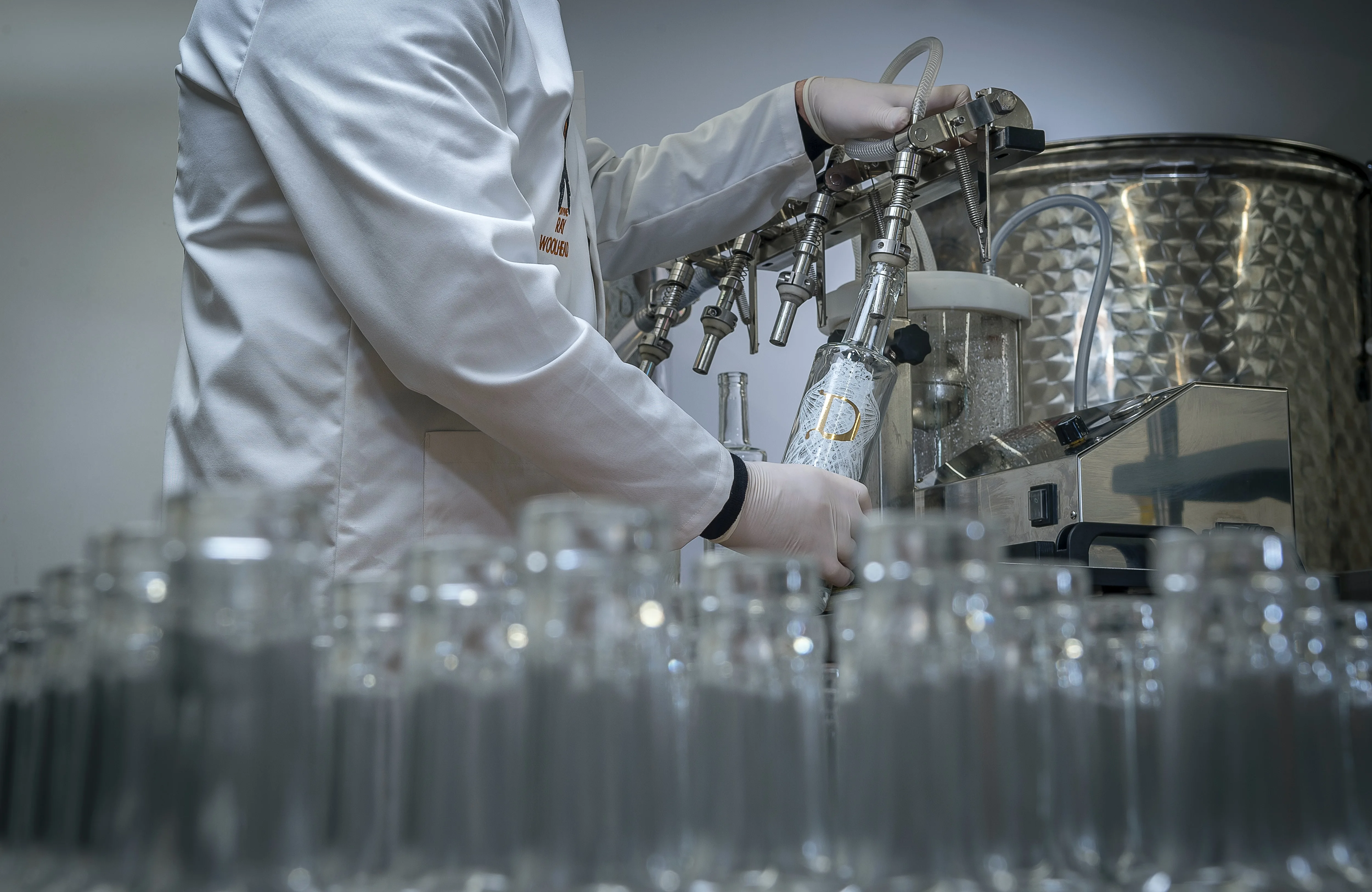
How the cosmetics industry, a complex and highly regulated industry, is moving towards process simplification to optimise its production performance.
What Is Industrial Automation?
An industrial production process consists of a series of machines through which a combination of raw materials passes, transforming to yield a finished product. Today, part of these production processes is automated. This means that some equipment contains digital programming designed to reduce human intervention in decision-making and in the manual control process, through the addition of mechanised equipment.
A fully automated production line is a set of machines and systems that carries out the process with virtually no human intervention. Operators are then limited to supervising and monitoring the proper functioning of the systems.
There are also semi-automated systems, in which operators work in collaboration with automation. This may include, for example, tasks requiring more dexterity than a human can reasonably provide. In such cases, it is possible to add collaborative robotics systems or other automated assistance systems.
Several factors may lead to considering industrial automation, such as:
- The demand for high-quality products,
- High product reliability,
- High-volume production, etc.
What Are the Different Types of Industrial Automation?
Industrial automation systems generally fall into 3 types:
- Fixed or Rigid Automation Systems
This type of automation is generally used to perform repetitive tasks on a single product type. It allows no form of flexibility due to the presence of equipment dedicated to that product type. It does, however, enable production rates to be drastically increased through continuous operation, and thus improves production efficiency.
This type of automation is generally accompanied by a significant initial investment, and is therefore suited to products manufactured in large quantities.
- Programmable Automation Systems
These automation systems are used for the production of product batches, where the instructions change depending on the product being manufactured. As the name implies, the programme is reprogrammed for each batch, each time with specifications according to the type of product being produced.
This automation can be time-consuming, as equipment and programmes must be changed from one batch to the next, leading to production stoppages.
Programmable automation is generally suited to medium volumes.
- Flexible or Soft Automation Systems
Flexible or soft automation is similar to programmable automation in that it offers the same degree of flexibility. However, product changeovers occur automatically and rapidly via the control system, which limits downtime compared with programmable automation.
This type of automation is suited to low volumes.
What Are the Benefits of Industrial Automation?
The fundamental drivers for implementing industrial automation are:
- Increased productivity,
- Improved industrial performance,
- Reduced operating costs,
- Reduced human error,
- Improved product quality,
- Reduced production lead times,
- Increased reliability,
- Increased flexibility,
- Increased commercial benefits.
Industrial automation also offers further advantages, including creating a safer environment for operators, improving working conditions by eliminating repetitive tasks, and reducing environmental pollution.
All these benefits will generate further positive effects, such as a more productive workforce.
- Specifics for the Cosmetics Industry
Growing production demand in the cosmetics industry is driving this industry to automate its processes in order to increase production rates.
Process automation is particularly advantageous in the cosmetics industry, enabling in particular:
- High-speed production
- Elimination of residual contamination: certain robots are designed to clean residual particles or contaminants deposited during production.
- High precision in application and packaging: thanks to sensors, the same quantity of product is dispensed into each bottle. This simplifies quality checks.
Furthermore, certain robots are equipped with self-adjusting grippers and auxiliary features expressly designed to minimise the risk of scratching bottles, preventing damage to the aesthetics and overall quality of the finished product.
What Are the Limitations and Drawbacks of Industrial Automation?
Industrial automation has its limitations and drawbacks.
Its main drawback lies in the initial investment it requires. Although it enables savings on operating costs, implementation costs are indeed very high. Moreover, additional costs should be anticipated for staff training — to ensure automated equipment is operated and maintained correctly — as well as for machine maintenance, to keep equipment in good working order at all times.
It is therefore imperative to study potential automation thoroughly, to ensure the return on investment is maximised. Companies generally adopt an overall Lean manufacturing strategy, whereby automation is only integrated into assembly stages if it creates added value, in order to optimise processes and promote the optimal use of human skills.
Read next
Expert guide
Short Interval Management (SIM): an Essential Lean Management Tool
What is Short Interval Management (SIM)? Short interval management (SIM) is a key Lean Management tool. Its objectives are to share common goals by d…

Interview
[ Interview 4.0 ] Harness the power of the digital twin to model an industrial environment
A digital twin is a virtual replica of a physical object. In most cases, digital twins used in industrial environments are innovation tools dedicated…
Expert guide
8 challenges faced daily by cosmetics manufacturers
Challenge no. 1: Production scheduling To plan production with all the necessary information to hand, several prerequisites are required: Having exce…