
Product · ROBIN.Scheduling
The flight plan, continuously optimised.
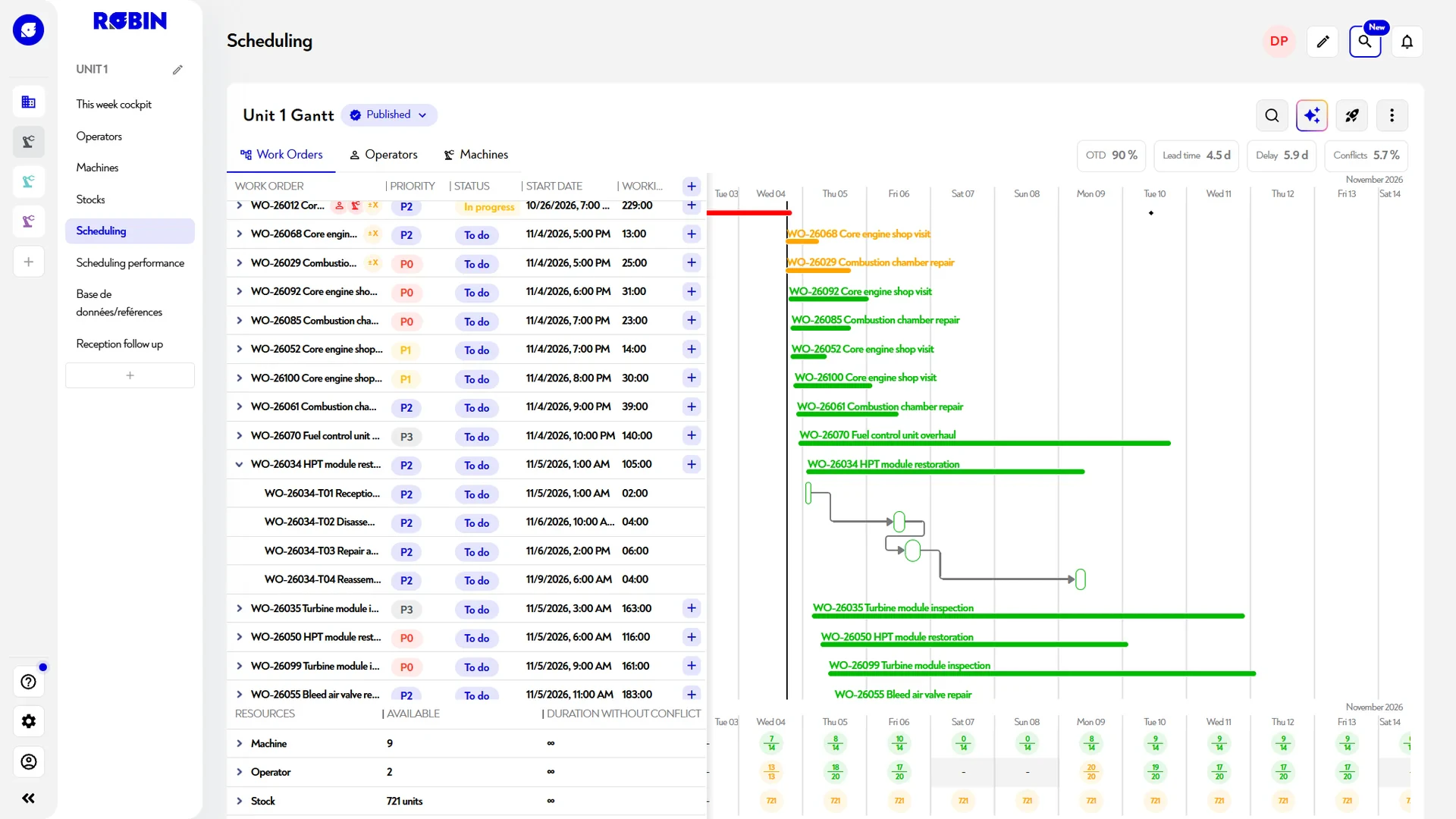
Dynamic finite-capacity scheduling: planning, arbitration, and decision-making. The schedule recalculates in real time based on the actual state of the shop floor — not a Gantt chart frozen at the start of the day. It is the fastest scheduling engine on the market: 4,200 operations recalculated in under three seconds, real constraints included.
- Dynamic scheduling
- Finite capacity
- Scenario simulation
- Continuous learning
Chapter 01
Plan to finite capacity, continuously
The plan factors in resources, materials, skills and customer commitments simultaneously — and recalculates as soon as a constraint changes.
Continuous dynamic scheduling
The schedule recalculates in real time based on the actual state of the shop floor — not a static Gantt chart from the morning.
Priority & constraint management
AOGs, contractual deadlines, resource availability and materials are taken into account simultaneously.
Automatic WO sequencing
Proposes the best sequence according to your business rules (TAT, OTD, load, criticality).
Chapter 02
Make trade-offs on facts, not gut feeling
Every decision is made on compared scenarios and the real state of the shop floor, with the scheduler in command.
Scenario simulation
Compare several scheduling options before deciding — an informed trade-off, not an intuitive one.
Shop floor synchronisation
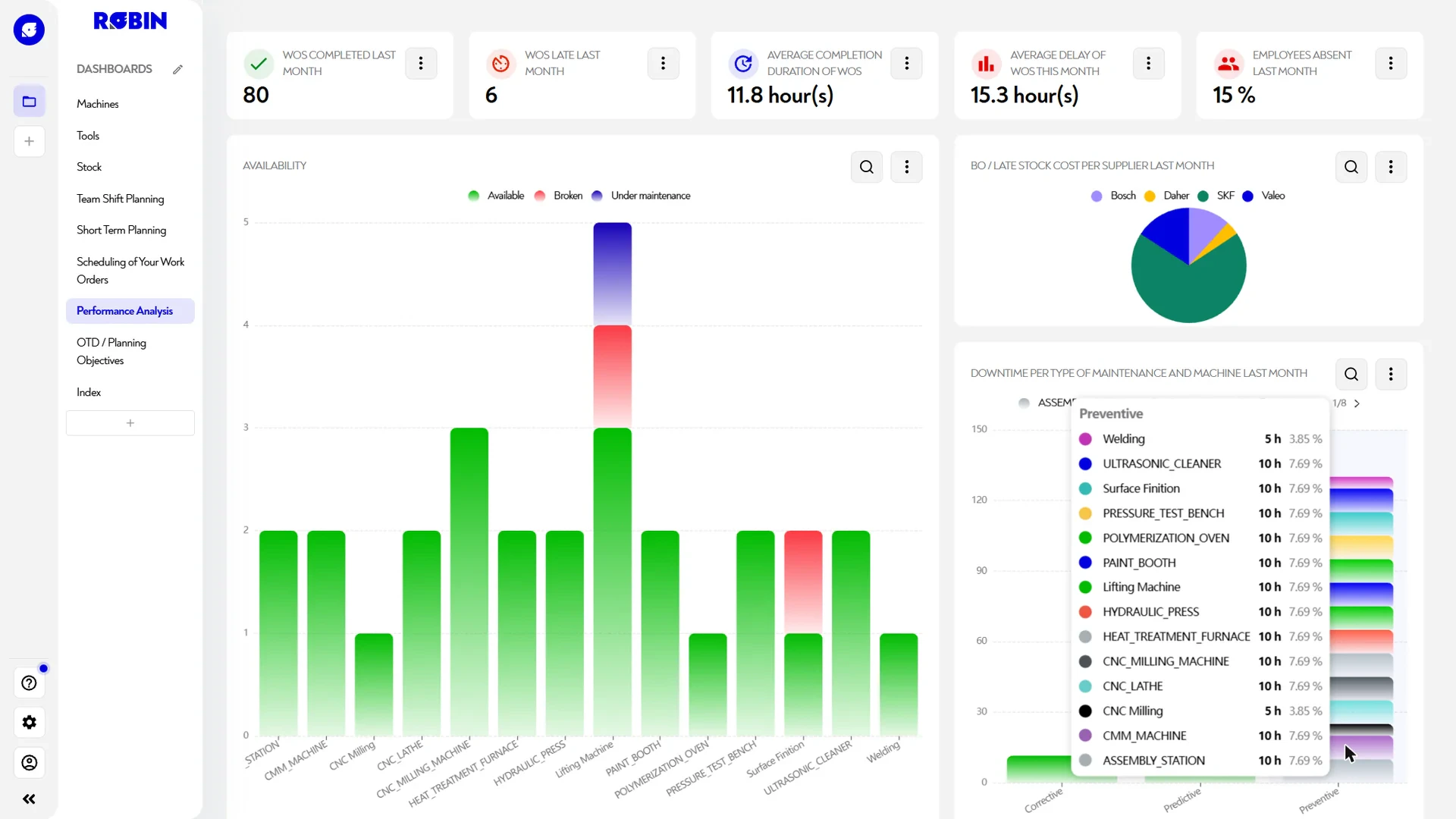
A schedule fed by live data from Tracking & Cockpit — what is planned reflects what is really happening.
Decision support when things drift
When a WO slips, ROBIN proposes a rescheduling — the scheduler makes the call instead of reacting after the fact.
Chapter 03
Measure the plan and learn from execution
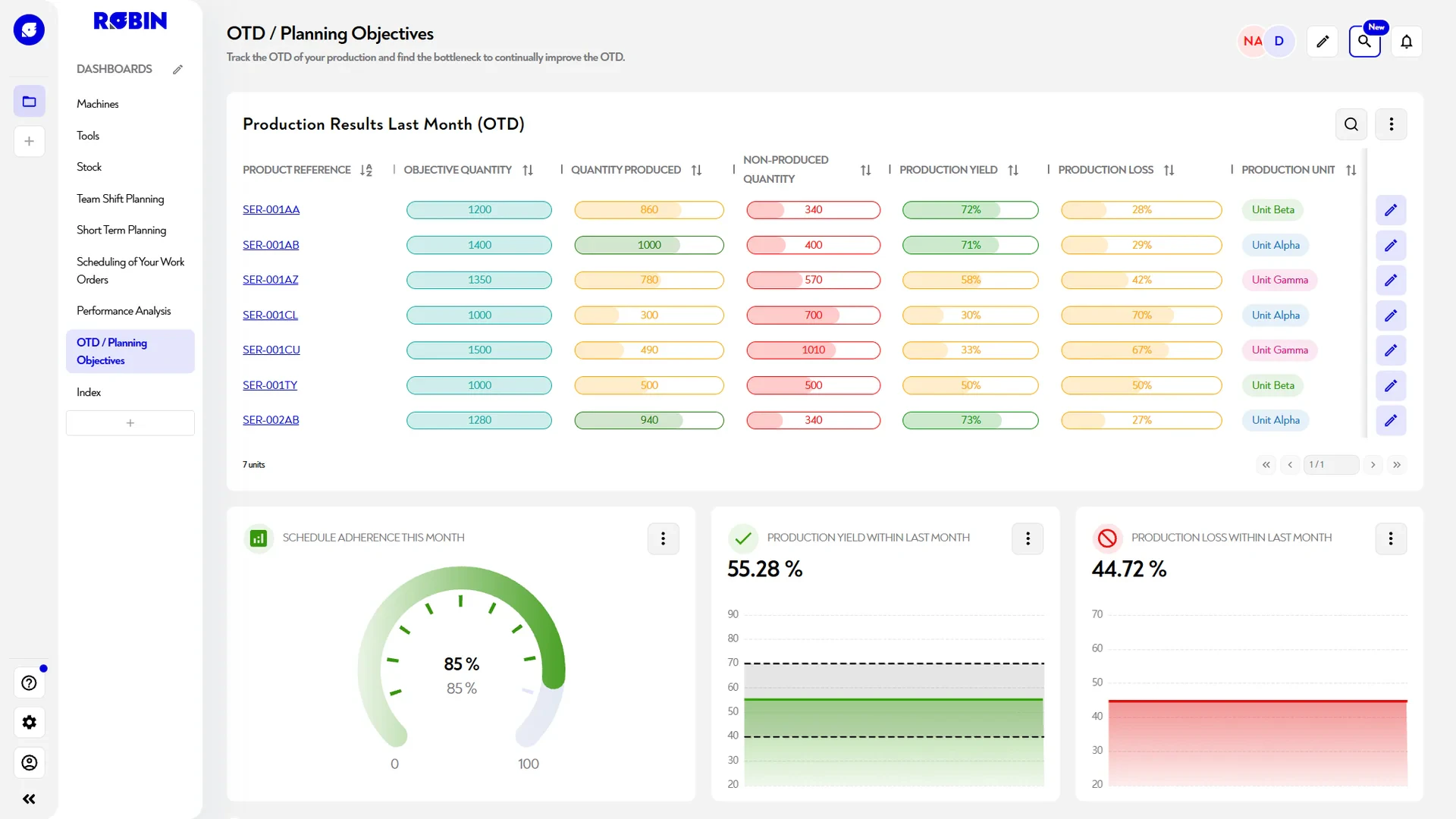
The gap between plan and execution feeds the model: routing times move closer to reality with every cycle.
Continuous learning
Learns from past operations to suggest a real routing time rather than a theoretical one, which improves schedule adherence.
Plan performance indicators
Schedule adherence, TAT, lead time, OTD.
Continuous rescheduling
One disruption, and the sequence rebuilds itself.
The plan is not set in stone. Move an operation in the schedule below, run the optimisation, and watch how ROBIN rebuilds the sequence under capacity constraints, without starting from a blank sheet.
Dynamic scheduling
The plan drifts. One click puts it back on track.
Eight orders, six resources, one week. Reschedule and watch each bar move back ahead of its due date.
Dynamic scheduling
Drifted plan — 8 orders late
Optimised plan — all orders on time
8 late0 in the plan
0 late8 in the plan
The dotted marker shows the due date · a bar turns green when the order finishes before its own.
The learning factory
Routing times converge towards reality, week after week.
A learning factory doesn't launch a time-study campaign: it measures what it does. ROBIN compares each executed operation with its theoretical routing time, then corrects the standard. The more the shop floor runs, the closer the plan sticks to what will actually happen.
Continuous learning
The gap to reality closes by itself.
Every declared operation corrects the standard times. The plan stops drifting because it learns from the shop floor, not because someone readjusts it by hand.
Planned vs actual routing time
Deburring — finishing station · actual time / standard time ratio
current gap high · +26 %
production weeks
Average ratio
135 %
Standard deviation σ
± 15.2 %
Measurements
24 WOs
Schedule reliability
schedule adherence rate
77 %
Corrections proposed by Robin
Deburring — finishing station
takes +40 % longer than standard on average
Dimensional inspection — CMM
takes +22 % longer than standard on average
Sub-assembly A
takes +31 % longer than standard on average
Robin is observing your actual times… move the weeks forward to see the first corrections.
An order of magnitude modelled from our deployments, not a measurement from a client site.
Industries
Your scheduling constraints, not a generic model.
Variable routings, disruptions, urgent customer orders: trade-off rules are configured industry by industry.

Aerospace · MRO
MRO & repair
Routing disruptions, AOG, customer-supplied parts: the flow is rebuilt several times a day.

Aerospace · Production
Production & assembly
Rate, assembly stations and shortages across long production runs and short cycles.

Industry · Multi-industry
Manufacturing industries
Mixed flows, subcontracting and WIP scattered across several buildings.
Frequently asked questions
What teams ask us about ROBIN.Scheduling.
What is the difference between static and dynamic scheduling?
Static scheduling freezes a sequence at a given moment, often in the morning: it becomes obsolete at the first disruption. Dynamic scheduling recalculates the sequence at every shop-floor event, within the same constraints, without redoing everything by hand.
How long does a full recalculation take?
About two minutes* for a complete reschedule after a disruption, so trade-offs can be made during the production day rather than the next morning.
*Average observed duration. It varies with the number of work orders to schedule.
Does ROBIN decide instead of the scheduler?
No. ROBIN proposes a sequence and quantifies the impact of each option; the decision remains human. The scheduler can freeze an operation, force a customer priority or compare two scenarios before publishing, and the engine recalculates around those decisions instead of overriding them. The shop floor receives a sequence someone has validated, not an unreviewed automatic output.
How are AOGs and urgent cases handled?
Contractual priorities, AOGs and criticality levels enter the calculation as explicit constraints, alongside resource and material availability. ROBIN does not decide for you: inserting an urgent job is simulated before validation, with the list of orders it pushes back and by how much.
Once the plan is validated, the work queue is reordered at the workstation with the reason shown (customer priority, milestone at risk, rework), and any delay caused elsewhere is recorded with its cause.
Does ROBIN schedule at finite capacity?
Yes. The schedule accounts for real-world capacities: machines, qualified operators, tooling, containers, and available materials. An operation is never assigned to an unavailable resource.
They use it

The platform's effectiveness becomes apparent after a few months of use: yes, the solution has a significant impact on productivity. The biggest time loss was due to machine stoppages — with Zozio, we manage to keep them running continuously.
 All testimonials
Going further
What we write about ROBIN.Scheduling.
Article
Static vs dynamic scheduling
Legacy tools take a snapshot of the plan. Dynamic scheduling films the flow.
Article
Industrial antifragility: designing a plan that gains from being disrupted
Absorbing disruption is no longer enough.

Case study
Reducing TAT in an MRO shop floor
Continuous rescheduling and schedule adherence on a real shop floor.
In the platform
One platform, six building blocks.
From deployment to scheduling, each building block feeds the next — a single reference base, a single flight plan.
Take action
See ROBIN.Scheduling on your data.
A demo prepared with a scheduling engineer, on your shop floor.