
Industries · Aerospace — Production
Your machines are not the bottleneck. Your scheduling is.
Small batches, long routings, critical resources shared across programmes. When the rate ramps up, it is the ability to re-sequence that limits the shop floor — not the number of spindles. ROBIN schedules to finite capacity and recalculates at every disruption.



Who it's for
Aerospace manufacturing and assembly shop floors — detail parts, sub-assemblies, structures, equipment. One-off production and small batches, from 30 to 800 people.
What ROBIN does
Finite-capacity scheduling of all operations, rescheduling in under two minutes after a disruption, and real-time WIP tracking by geolocation — with no operator input.
What it changes
A workable plan instead of a theoretical one: load levelled across critical resources, reliable delivery dates, and a quantified answer to the question „can we take this order?“.
Industry challenges
A job shop isn't run like a line.
Each WO follows its own routing, passes through the same critical resources, and runs into the same queues. The complexity isn't in the operations: it's in their order.
Rate ramp-up
The rate is going back up, but the shop floor hasn't changed size.
Aerospace order books demand double-digit ramp-ups without proportional investment. The lever available is the use of existing resources — hence sequencing. Without a finite-capacity plan, ramping up the rate is paid for in overtime and emergency subcontracting.
Product diversity
Hundreds of part numbers, no two routings alike.
One-off parts, spares, pre-series and established series share the same machines. Tools designed for a linear flow can't arbitrate between them — the trade-offs fall to the scheduler, who redoes them every morning in Excel.
Critical resources
Surface treatment, NDT, furnace, test bench: the bottleneck is shared.
These resources serve every programme, and impose campaigns and fixed minimum durations. A sequencing error in front of a furnace doesn't cost an hour: it pushes everything downstream back by several days.
Load vs capacity
The order book is firm. Capacity moves every day.
Absences, unplanned maintenance, operator qualifications, unavailable tooling. A load-capacity match calculated monthly says nothing about next week — and next week decides whether the delivery goes out.
What ROBIN brings
A workable plan, recalculated at the pace of the shop floor.
Facing critical resources
Finite-capacity scheduling, operation by operation.
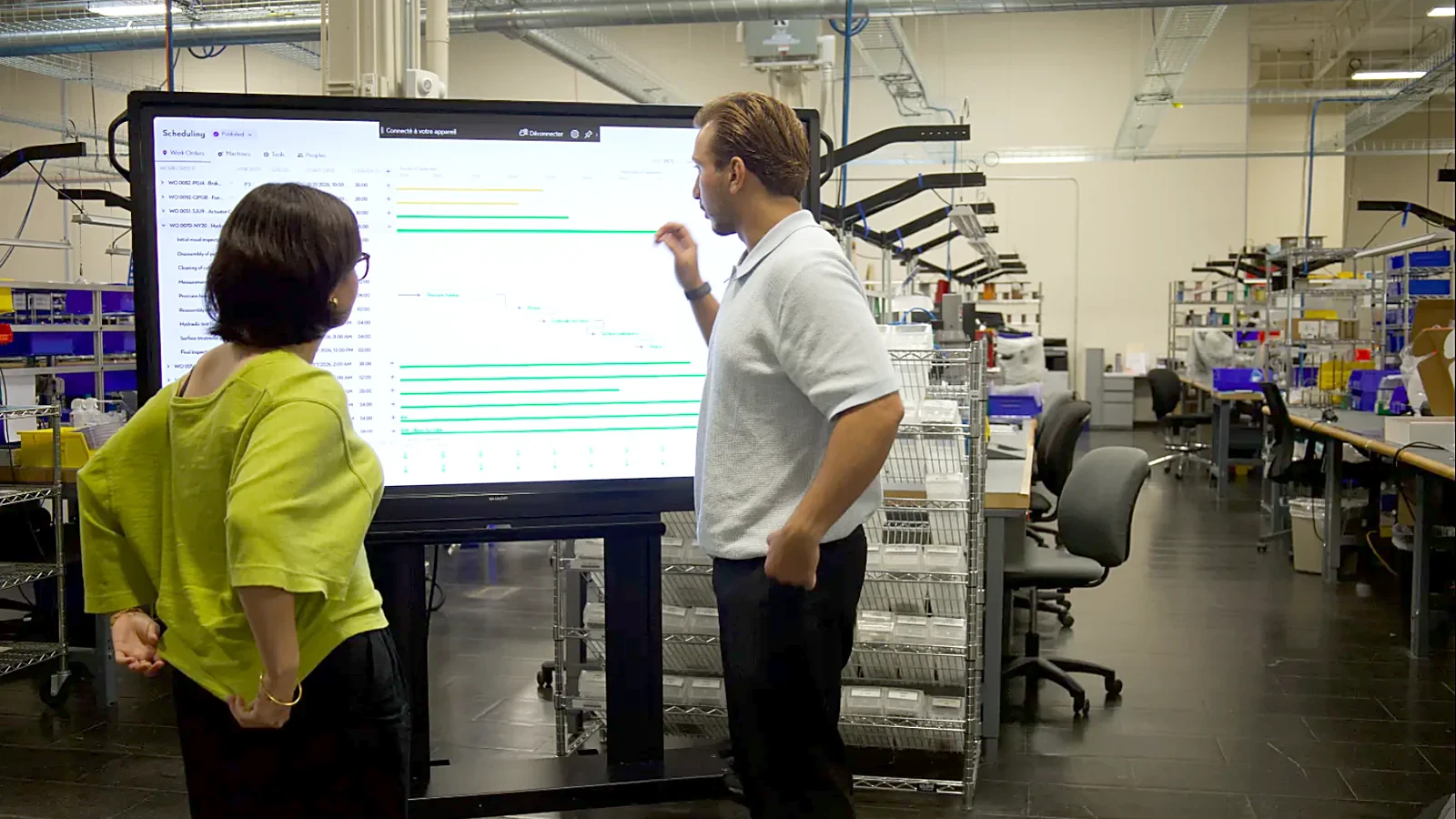
ROBIN sequences each operation on each resource, factoring in routings, qualifications, tooling, changeover times and unavailability calendars. The resulting plan is executable as is — not a target to correct the next day.
- Multiple constraints: machine, operator, tooling, material
- Optimised sequences to reduce changeover times
- Configurable business priorities — customer, programme, criticality
Facing the rate ramp-up
Simulate the rate before committing to it.
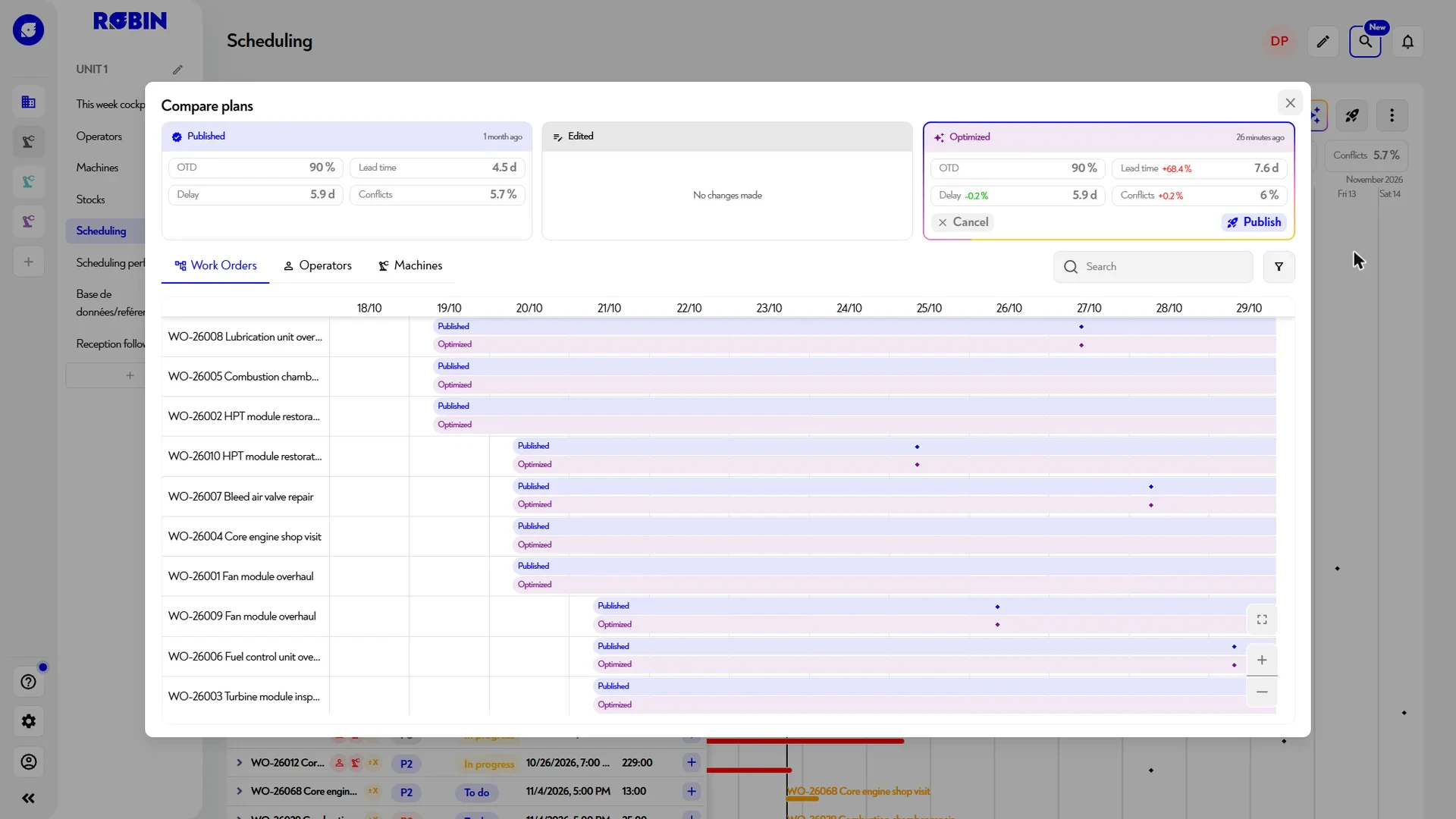
Before confirming a ramp-up, test it. ROBIN projects the load onto your critical resources, shows where the bottleneck will move and compares scenarios: additional shift, subcontracting, machine investment. The decision is made on dates, not on conviction.
- What-if simulation on load scenarios
- Load-capacity match by week and by workstation
- Quantified answers to sales requests
Facing the shop floor's blind spot
Know where the WIP is, without asking operators.
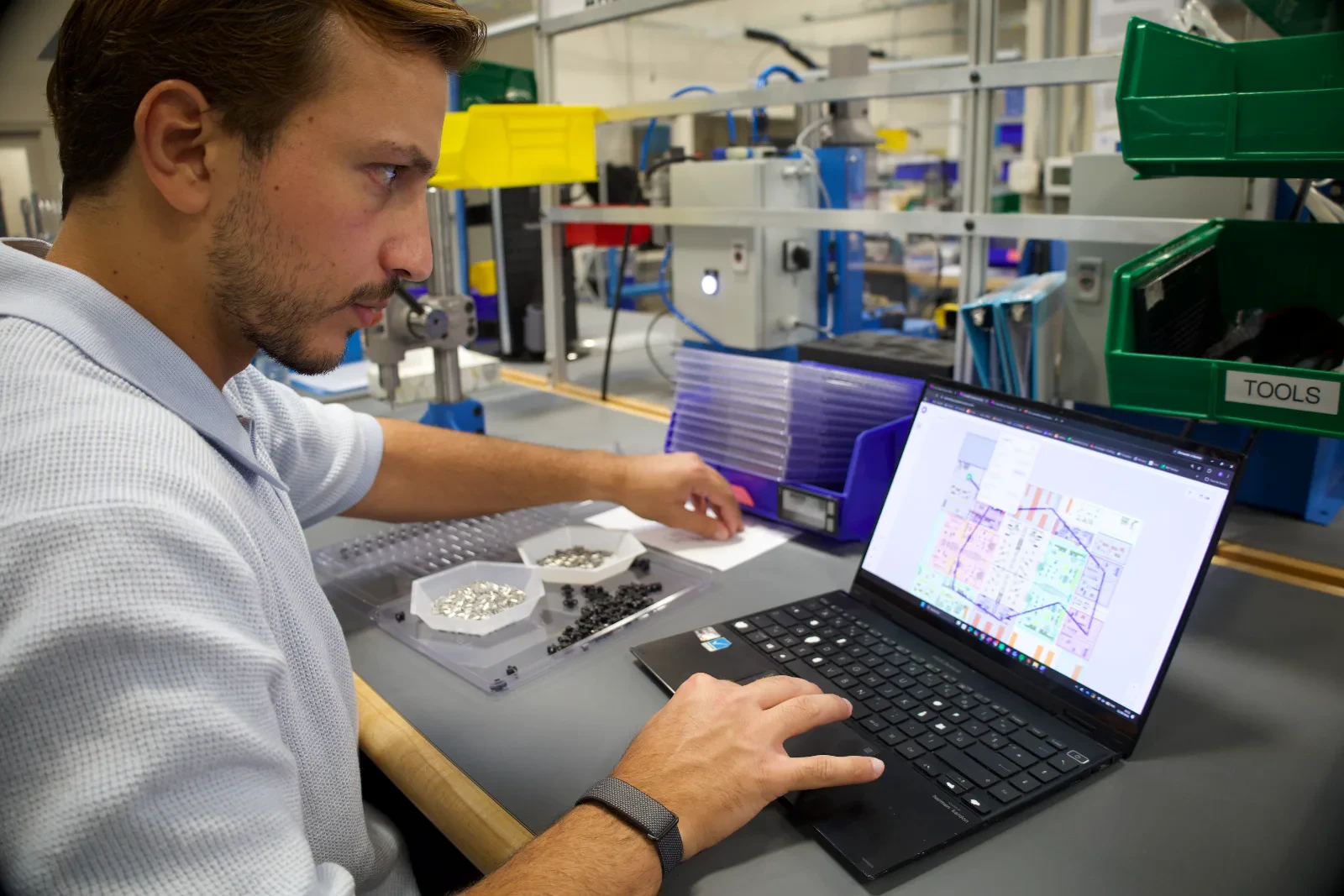
Native geolocation continuously tracks WOs, bins, tooling and handling equipment. Actual progress is reported without manual entry, and comparing theoretical and actual times gradually makes routings more reliable.
- Real-time WIP tracking, with no manual reporting
- Theoretical vs actual gap per operation
- Timestamped, auditable traceability
They produce in aerospace

On the production side, Daher manufactures aircraft — different types of aircraft — and in our business, we have a genuine need for real-time visibility into our physical flows. […] All of this, combined with Zozio's algorithms and expertise, enables us to improve our production and logistics operations. Knowing in real time the position and status of parts currently in production allows us to be almost “omniscient” about our production flow.
 Aerospace · ProductionAll testimonials
Use cases
What aerospace lines come looking for.
Three situations that production sites bring to us most often, and how ROBIN handles them.

Optimise resources
Load levelled across critical machines and scarce skills. The rate holds without forced overtime.
See the use case
Customer service level
The prime contractor's need dates are propagated down to the operation, and drifts are flagged before they become delays.
See the use caseManage disruptions
Machine breakdown, non-conformance, supplier delay: the sequence readjusts itself without going back to a spreadsheet.
See the use case
FAQ · Aerospace production
Questions from production shop floors
What is the difference between ROBIN and our ERP's MRP?
MRP calculates requirements at infinite capacity: it says what to produce and by when, without knowing whether the shop floor can deliver. ROBIN is an APS that schedules at finite capacity — it sequences every operation on every resource, taking into account real-world availability, routings, and shop floor constraints. The ERP remains the system of record; ROBIN takes over for detailed scheduling.
Our workshops handle one-off parts and small batches — does ROBIN manage both?
How does ROBIN support a production ramp-up?
ROBIN simulates the future load on your critical resources before you commit to the ramp-up rate. You can see where the bottleneck will shift, which lever addresses it — hours, subcontracting, investment — and which delivery date each scenario can sustain.
How long does a ROBIN deployment take?
From signature to go-live, allow less than three months in most cases, support included, where heavyweight APS projects take 16 to 24 months. A demonstration on your own data can be set up in a few days.
You then start on a critical scope (a workshop, a line, a resource) and extend at your teams' pace. Most of the work goes into structuring routings and resources, not into configuring the software. The timeline is split into phases, with milestones and success criteria defined at the outset.
Take action
Is your schedule capping your production rate?
Let's talk about your shop floor — a demo on your own data is possible within a few days.