
Industries · Manufacturing industries
Your shop floor changes configuration every day. Your schedule doesn't.
Wide product mix, constrained campaigns, shared mobile resources, customer emergencies. A schedule frozen on Monday no longer reflects the shop floor on Tuesday. ROBIN schedules at finite capacity and recalculates whenever a constraint changes.




Who it's for
Job shop and batch processing shop floors: cosmetics and pharma, electronics, automotive and transport, textile and luxury, technical glass. Sites of 50 to 1,000 people, with a wide variety of part numbers.
What ROBIN does
Multi-constraint finite-capacity scheduling, geolocation of mobile resources and WIP, real-time management of load-capacity balance — connected to your ERP.
What it changes
The scheduler gets out of Excel, operators stop hunting for equipment, and management finally has a service level it can explain line by line.
Industry challenges
The complexity isn't in the product. It's in the mix.
Making one part number is simple. Making four hundred, on shared equipment, with sequencing constraints and daily urgent orders, is not.
Product mix
Ever-shorter runs, ever-firmer lead times.
Customisation and stock reduction are pushing batch sizes down. Every additional part number adds changeovers, adjustments and trade-offs — and manual scheduling hits its limit well before the shop floor does.
Campaign constraints
The running order costs more than the production itself.
Cleaning between families, format changeovers, grouping by shade or material: a poor sequence turns a productive day into a setup day. These rules often live in the head of a single person.
Mobile resources
Machines get planned; tanks, moulds and trolleys get forgotten.
Mobile equipment determines when a job can start as much as fixed machines do — and nobody knows where it is. The time spent looking for it appears in no indicator, yet it genuinely delays work orders.
Off-system planning
The real schedule lives in an Excel file, on a single workstation.
The ERP provides the requirements, the shop floor provides reality, and the scheduler reconciles the two by hand every morning. Know-how isn't captured, the workload is unsustainable, and one person's absence is enough to disrupt the whole week.
What ROBIN brings
Scheduling that knows your rules, not just your routings.
Facing product mix and campaigns
Sequence while respecting the real shop-floor rules.
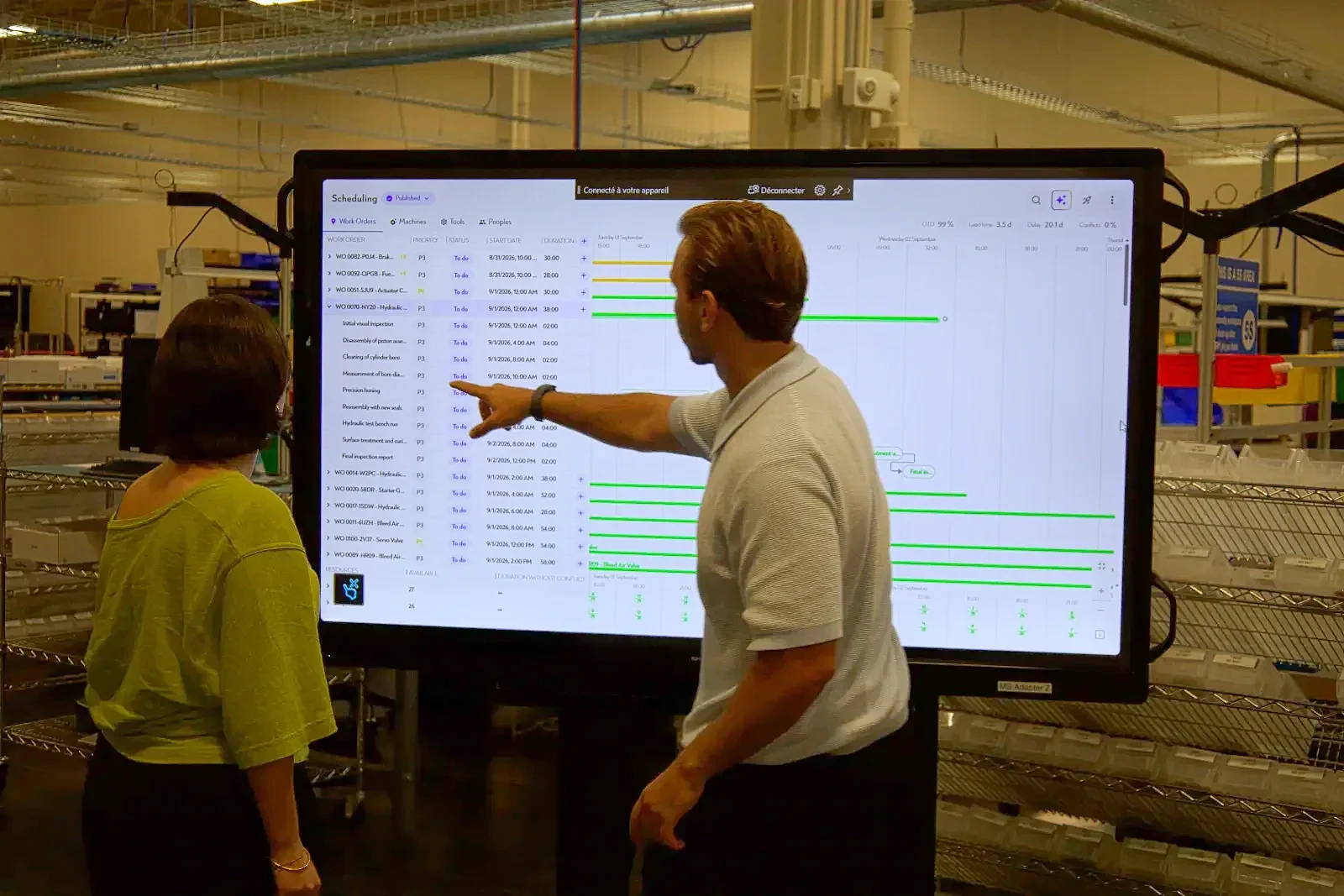
Sequence-dependent changeover times, campaign groupings, mandatory cleaning, product compatibility: ROBIN builds these constraints into the calculation and looks for the order that maximises productive time. The scheduler's know-how becomes a system rule, not a habit.
- Configurable sequence and campaign constraints
- Scenarios compared before validation
- Full rescheduling in under two minutes
Facing mobile resources
Every tank, mould and trolley located continuously.
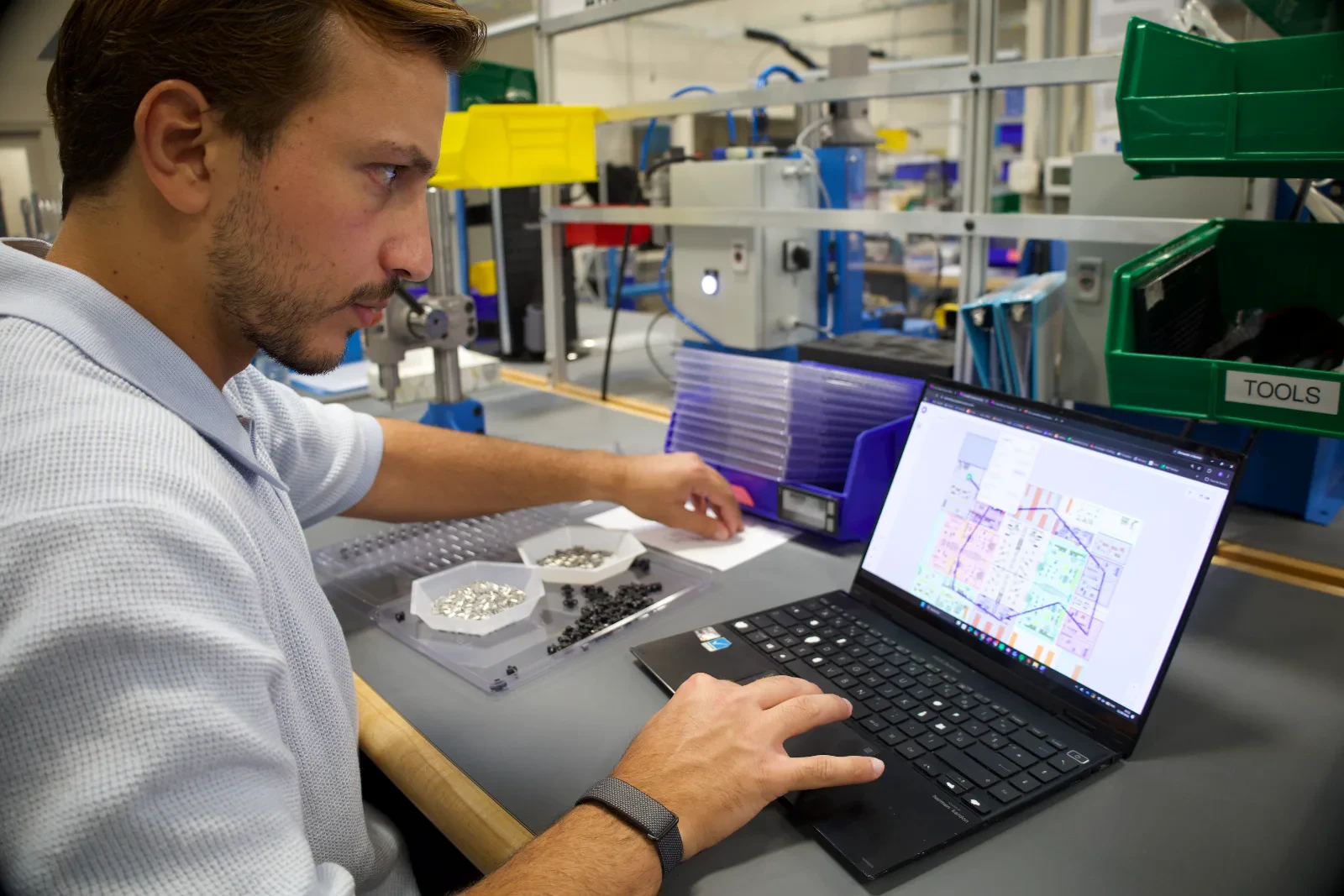
Indoor and outdoor geolocation tracks the mobile fleet without manual entry. Operators find equipment instead of hunting for it, container compliance can be verified at any time, and real availability feeds into the scheduling calculation.
- Mobile fleet tracked without manual reporting
- Status and compliance verifiable in real time
- Less mental load for teams
Facing Excel-based planning
Get out of the file without losing control.
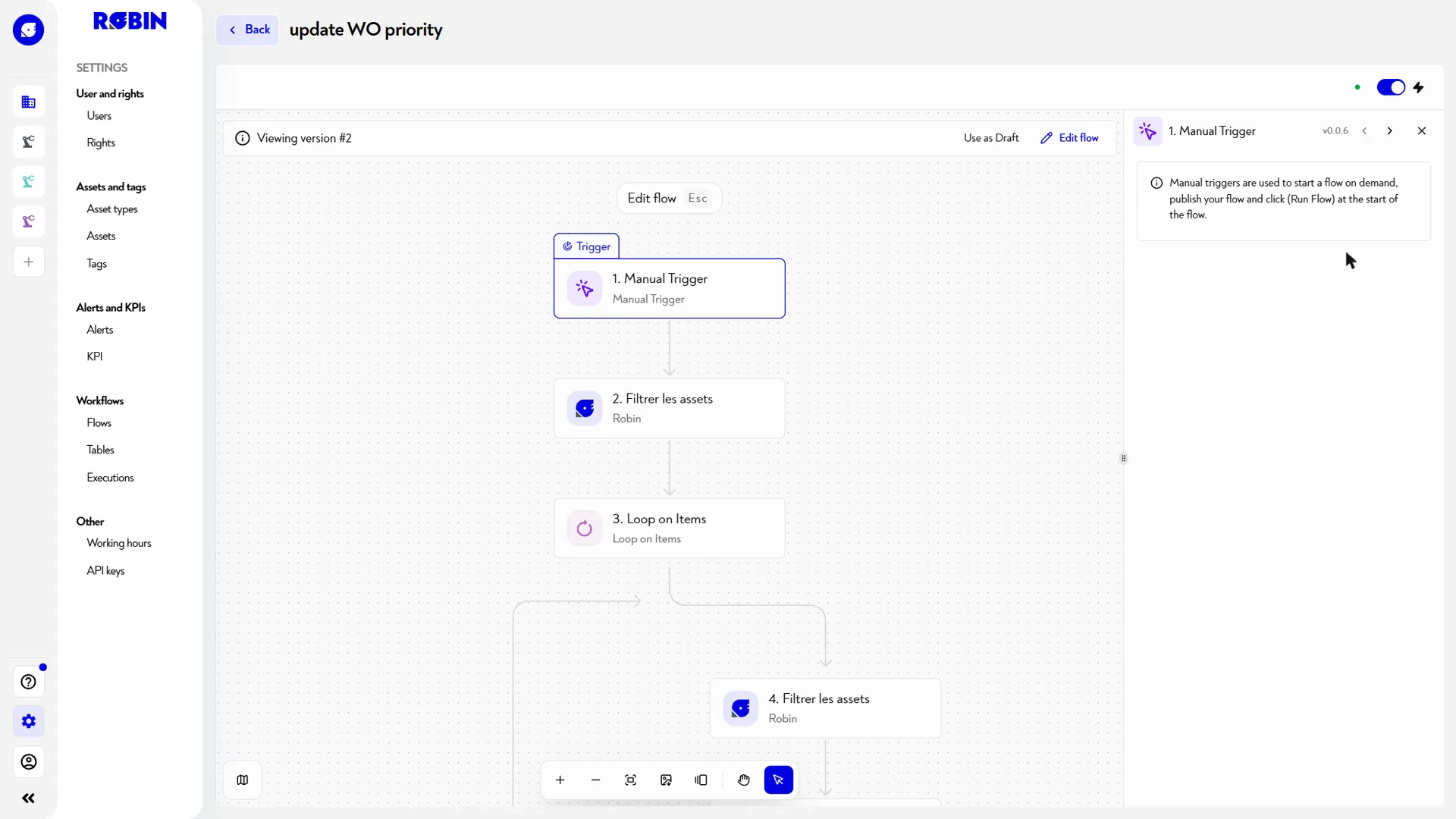
ROBIN picks up your ERP data through standard connectors, applies your rules, and lets the scheduler arbitrate where arbitration adds value. The plan can still be edited by hand — but it is recalculated, shared and traced.
- SAP, Sage and third-party ERP connectors
- Scenarios and drafts before publication
- Service and plan-adherence indicators
Your industry
The same foundations, different constraints.
The scheduling engine is the same. What changes are the rules to model and the indicators that matter.

Cosmetics & Pharma
Batch processing, mobile tanks, GMP traceability and mandatory cleaning between product families.
View the page
Electronics
Multi-part-number boards, bottleneck test benches, holding lead times on components that are still tight.
View the pageAutomotive & Transport
In-house micro-factories, prototypes and spare parts in a just-in-time environment.
View the page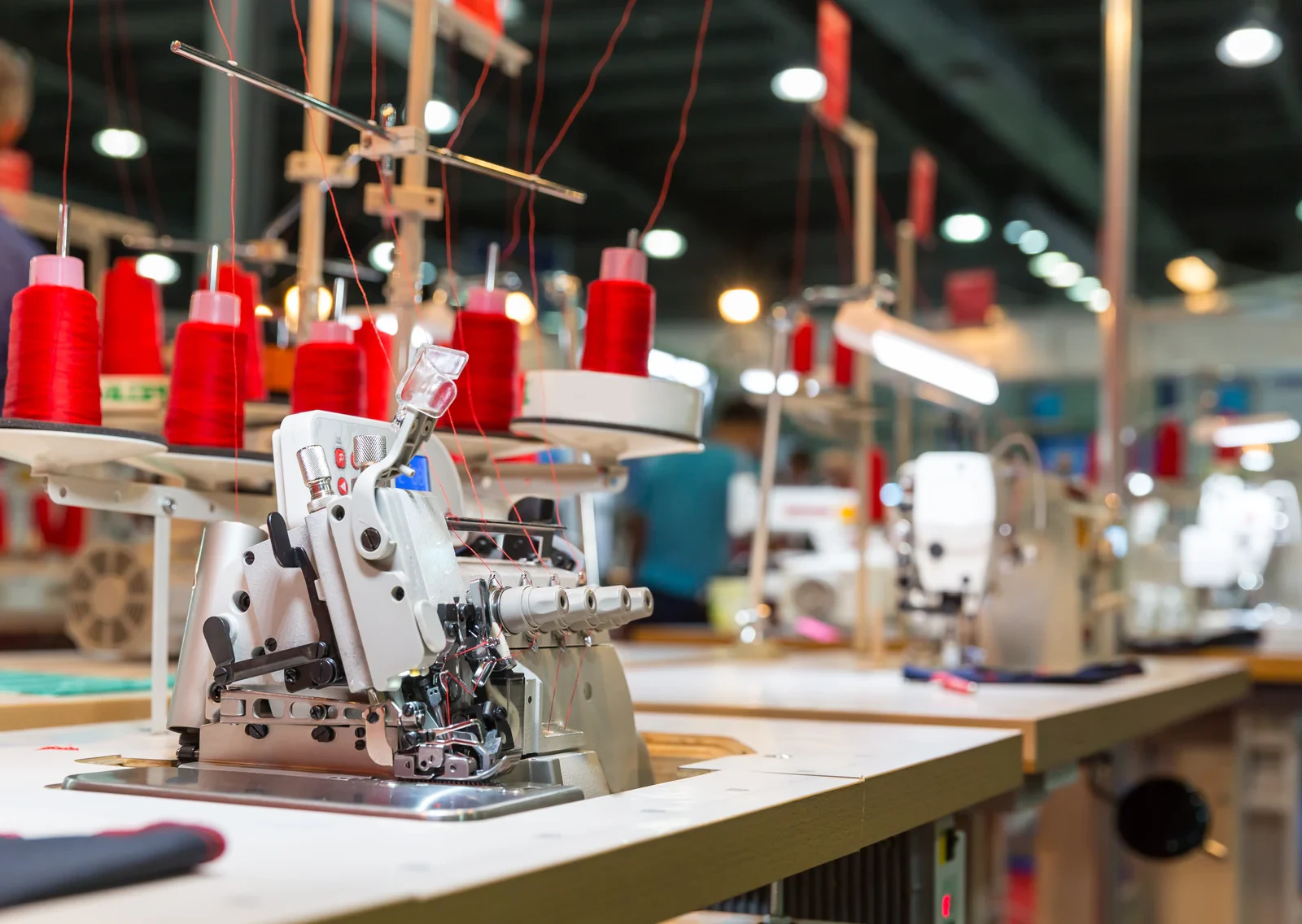
Textile & Luxury
Contract-manufacturing workshops, rare craftsmanship, collection peaks and uncompromising quality standards.
View the page
They run their shop floor with ROBIN
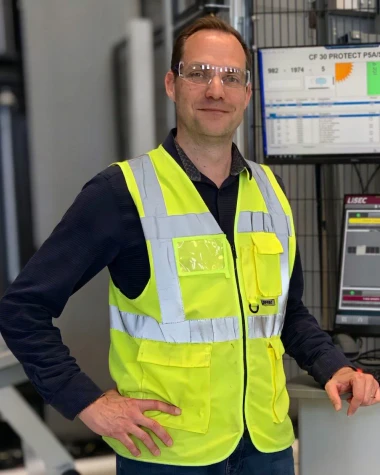
Zozio was the simplest solution to implement, and the most flexible. It enabled us in particular to increase the productivity of our main production line — which also means avoiding the need for additional teams at weekends during production peaks.
 Technical glassAll testimonials
Use cases
What manufacturing shop floors come looking for.
Three situations that sites bring us most often, whatever the product made.

Moving away from Excel-based planning
A single plan, shared from the shop floor to the methods office, that updates itself instead of being manually realigned every morning.
See the use case
Optimising resources
Load/capacity balance checked at every rescheduling: bottleneck workstations are levelled, changeovers grouped.
See the use case
Customer service level
Promised dates become a constraint of the plan, not a hope: OTD is managed day by day.
See the use case
FAQ · Manufacturing industries
The questions manufacturing shop floors ask
We plan in Excel — why change?
Excel can display a schedule, not recalculate it under constraints at every event. It knows neither the real capacity of your resources, nor sequence constraints, nor what is happening on the shop floor right now: the plan is right when printed and wrong an hour later. It relies on manual entry, concentrates errors and exists in only one up-to-date version, held by one person.
ROBIN takes the same data, adds the real constraints and shop-floor data (progress, WIP geolocation), and recalculates automatically at every event. Without that shop-floor data, a new planning tool would just be Excel with a different interface.
Does ROBIN handle batch processing and campaign constraints?
Yes. Campaign groupings, sequence-dependent changeover times, mandatory cleans between families, and product compatibilities are all built into the engine. ROBIN finds the sequence that minimises unproductive time whilst respecting these rules.
How does ROBIN track mobile resources — vats, moulds, and trolleys?
Via indoor and outdoor geolocation, with no operator input required. Each container or tooling item carries a tag; ROBIN continuously knows its position, status, and history. Teams stop searching for equipment, and actual availability feeds directly into the scheduling calculation.
Should we replace our ERP?
No. Your ERP remains the system of record for work orders, routings and bills of materials: it was designed for management, not for detailed scheduling. ROBIN connects to it through standard connectors (SAP, Sage and others) and takes over what it cannot do: dynamic finite-capacity scheduling and real-time shop-floor data (tracking, geolocation, actual progress).
The same goes for an existing MRO system: ROBIN pulls its work orders, routings and standard hours, and adds the layer it lacks. Your ERP investment is preserved.
Take action
Does your schedule depend on one file and one person?
Let's talk about your shop floor — a demo on your own data is possible within a few days.