
Industries · Automotive & Transport
Your internal workshops cannot afford to stop the line.
Prototypes, tooling, spare parts, and internally produced sub-assemblies operate as a job shop — yet are measured against the on-time performance of a just-in-time flow. ROBIN makes visible exactly what each urgent job displaces.

Who it's for
OEMs and equipment suppliers, in-house shops for prototyping, tooling, machining and spare parts, rail and special-vehicle sites. One-off production and small batches serving a paced flow.
What ROBIN does
Finite-capacity scheduling of these shops, insertion of emergencies with a simulation of their impact, and real-time tracking of progress and WIP.
What it changes
Emergencies stop being invisible: each one is inserted with its quantified cost on other commitments, and the trade-off is made before the delay, not after.
Industry challenges
A job shop serving a paced flow.
These shops work piece by piece, but their internal customers think in takt time. The gap between the two logics is paid for in emergencies.
Just-in-time
A two-hour delay shows up immediately on the line.
With no buffer stock, every shop-floor disruption becomes a risk of downstream stoppage. Room for manoeuvre is counted in hours, which makes reaction time more decisive than available capacity.
Constant emergencies
Every emergency re-sequences the shop floor without anyone measuring what it pushes back.
Line stoppage, quality rework, test request: priorities change several times a day. Without a recalculated plan, nobody knows which orders have just been sacrificed to meet the latest emergency.
Three flows, one shop floor
Prototype, series and spare parts compete for the same machines.
Three lead-time logics, three levels of demand, a single capacity. The trade-off between them is often made by voice, in favour of whoever insists the loudest rather than whatever is most urgent.
Customer requirement
Traceability is part of the contract, not a matter of goodwill.
IATF standards, OEM audits, proof-of-execution requirements. Reconstructing a part's history after the fact from scattered files costs time and weakens the customer relationship.
What ROBIN brings
Absorb emergencies and stay calm.
Facing emergencies
Insert an emergency knowing its risk.
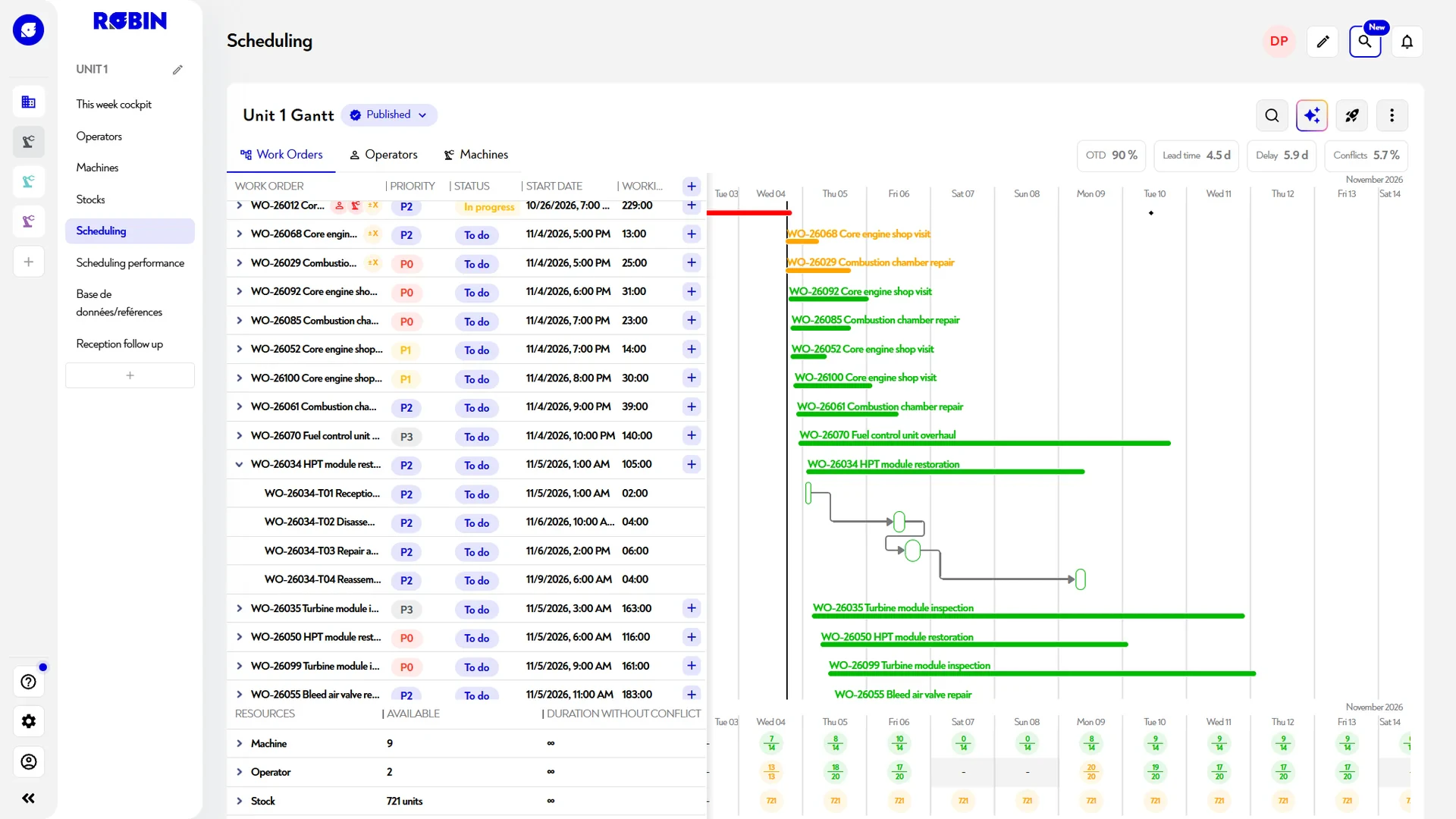
Before an insertion is validated, ROBIN simulates the resulting plan: which orders slip, by how much, and which become at risk. The trade-off becomes a documented decision rather than a reflex.
- What-if simulation before insertion
- Quantified impact on other commitments
- Full rescheduling in under two minutes
Facing competing flows
Prioritisation and trade-off rules that are easy for everyone to share.
We distinguish hard constraints (routing, machine capacity, qualification) from soft constraints (avoiding batch changeovers, keeping an operator on the same job, managing multi-skilling), then underlying objectives (minimise TAT, maximise service level, smooth the load). All of them can be configured easily and, above all, are propagated across the entire scheduling and work order (WO) orchestration system.
ROBIN.Cockpit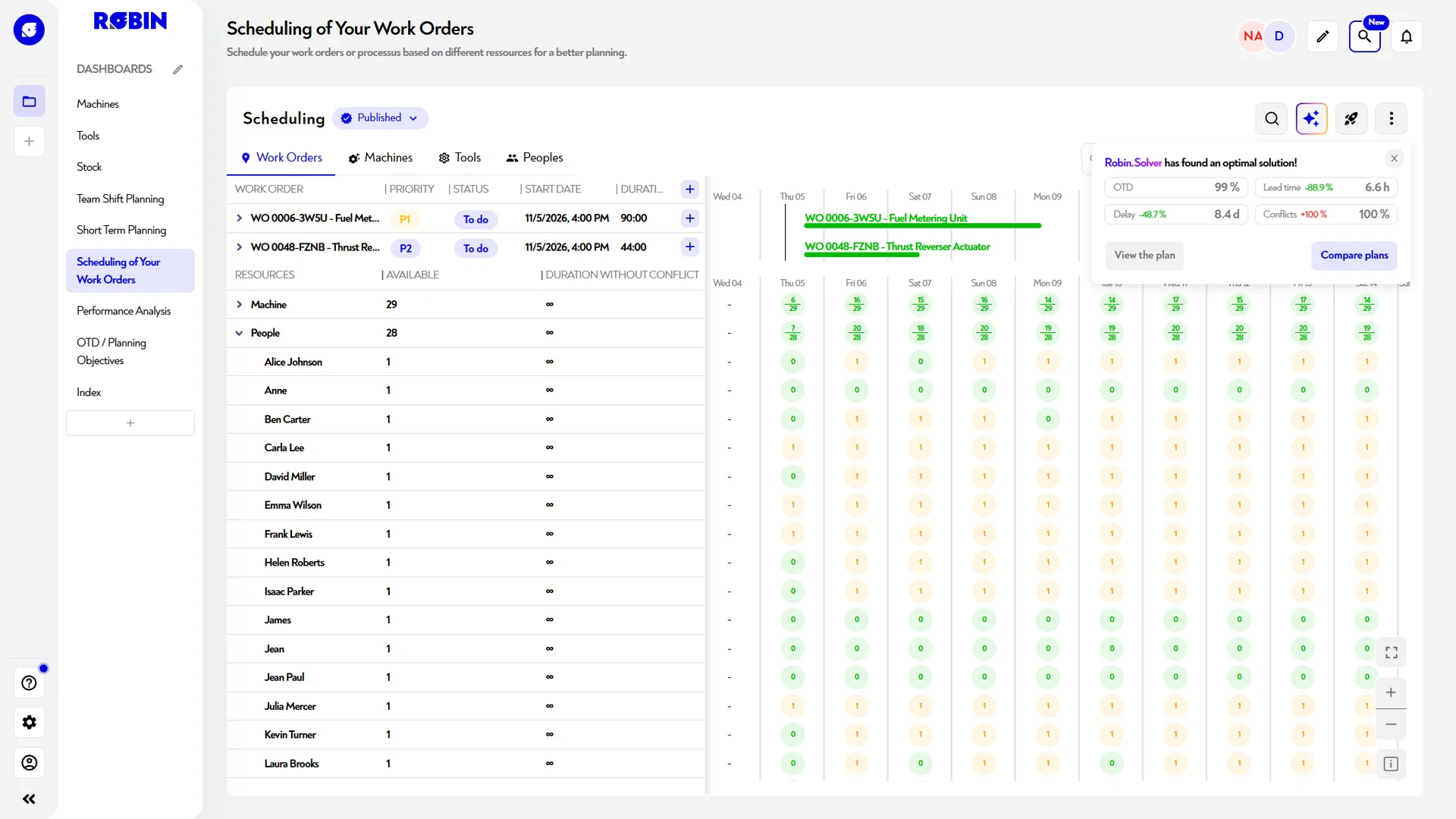
Facing proof requirements
The execution history is built up as work happens.
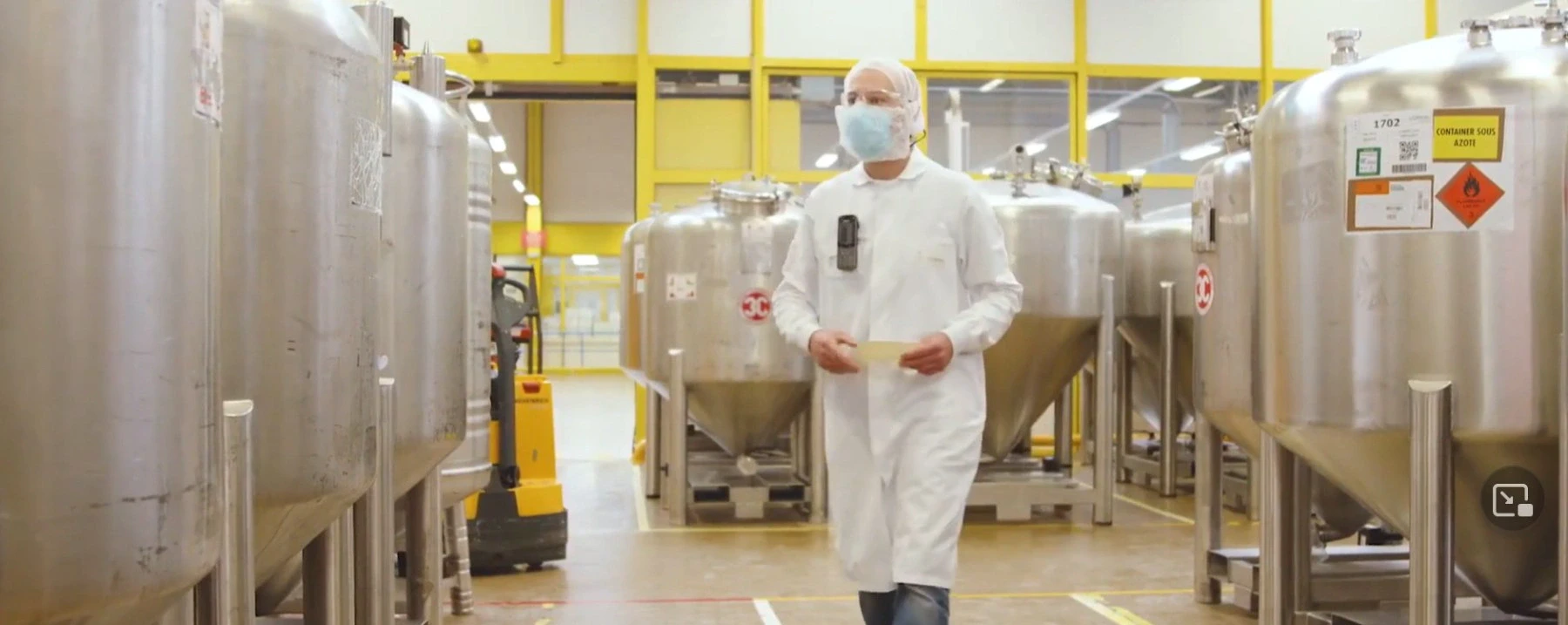
Real-time tracking of WIP and resources provides a timestamped history of every operation and every movement. Preparing for an audit no longer requires manual reconstruction.
- WIP tracking without operator input
- Timestamped, auditable history
- Gap between theoretical and actual times
They run their industry

The big vision is hyper-flexibility — the hyper-modularity of factories, which can be reconfigured very quickly to meet market demands. […] I am certain this will be the focus for Zozio, with a promising future ahead.
 Industry 4.0All testimonials
Use cases
What automotive and transport sites come looking for.
Three situations that shop floors working to customer pace most often bring us.

Customer service level
Delivery windows and OEM rates met, even when an urgent batch is inserted into the plan.
See the use case
Optimise resources
Batch changeovers grouped, load smoothed across bottleneck stations: existing capacity delivers more.
See the use caseManage disruptions
Breakdown, supply delay, rework: re-sequencing is immediate and every station sees its new priority.
See the use case
FAQ · Automotive & Transport
Questions from automotive and transport shop floors
How are AOGs and urgent cases handled?
Contractual priorities, AOGs and criticality levels enter the calculation as explicit constraints, alongside resource and material availability. ROBIN does not decide for you: inserting an urgent job is simulated before validation, with the list of orders it pushes back and by how much.
Once the plan is validated, the work queue is reordered at the workstation with the reason shown (customer priority, milestone at risk, rework), and any delay caused elsewhere is recorded with its cause.
Can prototypes, series production, and spare parts be managed within the same plan?
Yes, and that is precisely the point: these three flows share the same resources, so they must share the same plan. Relative priorities are configured by flow, customer, or programme, and applied consistently at every recalculation.
Does ROBIN meet IATF traceability requirements and customer audit demands?
ROBIN maintains a timestamped log of every operation, every part movement, and every rescheduling event, which can be consulted and exported. This log feeds your audit records; it complements your quality system without replacing it.
Our in-house workshops are small — is ROBIN sized for them?
Yes. Deployment starts on a limited scope — one workshop, one flow, one critical resource — and then expands. The complexity of a job shop lies in the variety of routings, not the number of machines.
Take action
Are your emergencies delaying orders nobody sees?
Let's talk about your shop floor — a demo on your own data is possible within a few days.