
Use cases · Reduce TAT
The only KPI that really matters in MRO
In aeronautical MRO, TAT is not an internal performance indicator. It is a contractual commitment to airlines with an aircraft grounded. Fokker Services Group carries out maintenance, repair and overhaul of equipment across 5 sites.
- Industry — Aeronautical MRO
- Scope — 5 maintenance sites
- Modules — Tracking · Cockpit · Scheduling
- Deployment plan — 9 months

Client background
TAT is a commercial commitment, not an internal indicator.
TAT (Turn-Around Time) — the time between receiving a piece of equipment and returning it to service — is the main differentiator for an MRO shop floor. Delivering faster than competitors, and hitting the announced date: that is where the market is won.
And one MRO specificity makes the problem harder than in manufacturing: the condition of the equipment is unknown on arrival. Operating time cannot be derived from a routing; it is discovered during the technician's evaluation. A static scheduling approach cannot survive that.
Daily life before ROBIN
The shared observation of every MRO job shop.
- No visibility on the progress of WIP: work in progress moves through the shop floor without any usable trace
- No software on the market is designed for the MRO job shop — dynamic architecture, operating times unknown on arrival, constant disruptions
- Shop-floor data entry is paper-based or absent, so business data is neither real-time nor structured
- TAT is observed after the fact, not managed
Where TAT is lost
TAT is not lost in the work. It is lost in the queues.
The MRO process mapped with the teams follows ten steps, from receipt to shipping. TAT is almost never lost in actual working time: it is lost waiting for evaluation, waiting for parts, waiting for a test bench, waiting for inspection. These are exactly the times nobody measures.
The MRO flow and its statuses
Step | ROBIN status | Role in TAT |
|---|---|---|
Equipment receipt | — | Starting point of the contractual clock |
Pairing / work order creation | — | Linking the equipment to the file |
Technician evaluation | Ready for evaluation → Unit in evaluation | Discovery of the actual operating time |
Process engineering | — | Definition of the actual routing |
Waiting for parts / supplier / warranty | — | The black hole of TAT |
First test (test bench) | — | Structural bottleneck in MRO |
Shop floor / assembly / works | Ready to build → In process | The only time actually worked |
Final test (test bench) | — | Second pass through the bottleneck |
Quality | — | Inspection queue |
Shipping | Ready | Stopping the clock |
The Zozio solution
Four building blocks, to move from observed TAT to managed TAT.
WIP tracking relies on two complementary sources: shop-floor reporting — a technician form on PC, tablet or PDA — and automatic tracking by geolocation. Where geolocation is enough, data entry is eliminated; where the information is business-specific — evaluation result, cause of blockage — the form structures it.
Building block 1 — Tracking
Real-time WIP tracking
Make every WIP item traceable, status by status, with automatic timestamping. ROBIN measures continuously, by department and by status, across 6 shop-floor departments.
- Weekly TAKT time by status, and monthly / annual cumulative on closed orders
- Average number of days spent in each status for open orders — the indicator that reveals the queues
- Touch time: the time actually worked, to be distinguished from lead time
- Efficiency by technician and by department — actual hours vs standard hours
- TAT and OTD retrieved from the client's MRO system
- FTR (First Time Right), cross-checked against the gap between planned and actual hours
- Test bench OEE — the test bench is a structural bottleneck in MRO
Building block 2 — Geolocation
Geolocation of WIP
Status-based tracking says which step. Real-time geolocation says where — and above all for how long. A catalogue of technologies to choose from depending on accuracy and environment: BLE, UWB, wired and wireless RTLS, GPS for outdoors.
- Live location of every work order, tool, container, kit and part in the hangar
- Status inferred from position: a geozone automation updates progress without manual entry
- Automatic WIP inventory by status, at any time
- Real-time and historical spaghetti diagram, by part and by family
- Block time on bench: the actual immobilisation time on the test bench, measured rather than declared
- Heatmap analysis of congestion zones
- ERP vs geolocation comparison: detect gaps between declared status and physical reality
- Measurement of the time from receipt to shop floor availability of ordered parts
Building block 3 — Tag
The connected electronic tag
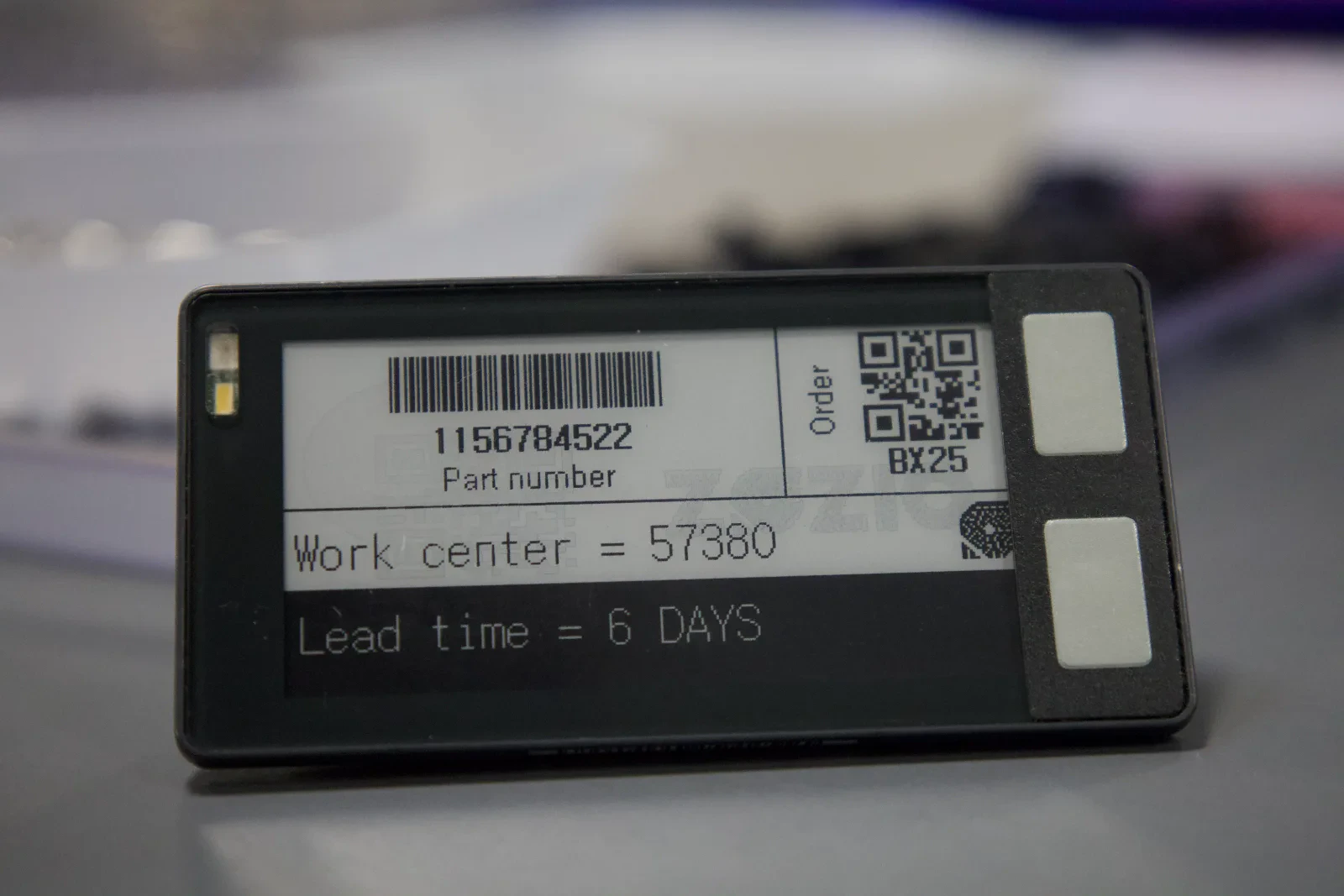
This is the building block that removes paper from the hangar — and with it part of the invisible TAT. The tag is attached to the equipment or work order, geolocated in real time and updated remotely.
- Displays up-to-date work order data without reprinting — no more outdated versions in circulation
- Communicates priority and sequence changes without waiting for the production meeting
- Carries a QR link to the technical documentation
- Is geolocated: equipment can be found instantly
- Shows the AOG (Aircraft On Ground) indication: emergencies are physically visible on the shop floor
- Secures digital sign-off — no more approvals lingering on a paper form
Building block 4 — Scheduling
Dynamic scheduling, phase by phase
The most structuring building block. The central concept is workable work: do not plan what cannot be done. A work order waiting for a part has no place in a technician's queue.
- This one rule, applied systematically, removes a significant share of parasitic TAT
- Priority score from 1 to 100 to arbitrate between workable orders
- Combined with shop floor screens: workable work by department, bench queue, named assignment
Implementation on the ground
Four phases, four go-lives.
The scheduling rollout at the US site follows the ROBIN.Deploy method on an incremental basis: 4 phases of 3 months, overlapping by one month, for a 9-month plan, with a go-live at the end of each phase. Each phase is a usable version of ROBIN, live and used in production immediately. Value accumulates, risk stays low.
Phase 1 — Technician availability
Integration of the existing algorithm, technician availability management, digitisation of the skills matrix, skill ↔ task mapping, optimisation by resource.
Constraint: peoplePhase 2 — Test bench capacity
Modelling of test benches as first-class steps, part ↔ bench mapping, capacity-based feasibility engine.
Constraint: test benchesPhase 3 — What is actually feasible, and in what order
Spare parts availability, work order template and default routing steps, scheduling by status — workable or not — and priority score from 1 to 100.
Constraint: workable workPhase 4 — ROBIN runs autonomously
Learning curve, ERP status vs geolocation comparison, parts at order level, receipt → shop floor lead time. Governance follows a set rhythm: weekly project meeting, monthly steering committee, hypercare period after each go-live.
Autonomous ROBIN
What is in place
The deployed scope, in figures.
- 5MRO sites within the group scope
- 6shop floor departments tracked on TAKT and efficiency, with dashboards by department and by role
- 4 × 3phases of three months, overlapping by one month — a go-live at the end of each
- 1 → 100prioritisation score for workable work orders
A digital twin of the MRO process was delivered as a custom development. What reducing TAT unlocks downstream: capital tied up in WIP released, fewer late deliveries and therefore fewer contractual penalties, capacity created without investment — and a sales argument, since TAT is the commercial differentiator of an MRO shop floor.
TAT reduction levers
Orders of magnitude modelled, not yet measured here.
These orders of magnitude are modelled by Zozio on the basis of comparable MRO shop floors. They do not come from measurements taken on this project.
Lever | Order of magnitude |
|---|---|
TAT reduction through queue elimination and dynamic prioritisation | −5 % to −15 % |
Operator time recovered from the “WIP hunt” | ≈ 6 % of operator time |
Reduction of manual re-planning through automatic scheduling | up to −80 % |
Lead time reduction through automatic re-planning | ≈ −20 % |
Time for a full scheduling recalculation after a disruption | under 3 seconds |
Before you start
What this project actually required.
The four questions every industrial leadership team asks before signing, and the answers as they proved true on this project.
Usable value at every phase
4 overlapping phases of 3 months, each closed by a go-live. Nobody waits nine months to see something, and risk stays low.
Your MRO system stays in place
Work orders, routings, standard hours and TAT/OTD are retrieved from the existing system. ROBIN adds real-time shop floor data and dynamic scheduling.
Your rules, not ours
Skills matrix, part ↔ bench mapping, workable work thresholds and a 1-to-100 priority score: the rules are co-built with the business, then adjusted without any development.
Paced governance
Weekly project review, monthly steering committee, hypercare period after each go-live. Hosting in France, Europe or the USA, GDPR compliance.
Go further
Related use cases.

Electronics
Real-time WIP visibility
The scan gives progress, geolocation gives position. It is the combination that ends the search.

Industrial job shop
Improve your service level
Make delays visible before they happen: dwell-time thresholds, alerts and shared priorities.

Multi-industry
Equipment optimisation and load levelling
Move from infinite to finite capacity: overloads detected at calculation time, no longer endured.
Frequently asked questions
Reduce TAT in MRO.
What is TAT in aeronautical MRO?
TAT (Turn-Around Time) is the total time between receiving equipment for overhaul and returning it to the customer. It covers everything: assessment, waiting for parts, work, testing, quality control, and dispatch. It is the primary contractual commitment of an MRO workshop to its airline customers.
Why is TAT hard to hold in MRO?
Because the condition of the equipment is unknown on intake. Operation time cannot be read from a routing: it is discovered at the technician's assessment. On top of that come waits for parts, supplier warranty and test benches: the initial schedule changes considerably, and without the right tool each reorganisation costs lead time, which adds up to days of TAT. Static scheduling cannot cope with this variability: it takes dynamic scheduling, able to recalculate continuously.
How to Reduce Your TAT in Practice?
By attacking queues rather than working time. Three levers, in this order: measure the number of days spent in each status and the actual position of WIP; only schedule workable work to avoid clogging the queues; automatically re-sequence at every disruption using a priority score.
What tracking should be implemented first on an MRO workshop?
Status and dwell-time tracking, before anything else. It requires no infrastructure and immediately delivers a map of the queues. Geolocation comes next, to eliminate manual data entry for everything that can be deduced from a position, automate stage-change tracking by geofence, and measure actual downtime on the test bench.
What is the difference between TAT and touch time?
Touch time is the time actually worked on the equipment. TAT is the total lead time. The gap between the two is waiting — and that is where most of the opportunity lies. Measuring them separately is the first step of any TAT-reduction project.
What role does geolocation play in reducing TAT?
Making wait time visible. Real-time geolocation provides actual dwell time by zone and by test bench, automatic WIP inventory, movement spaghetti diagrams, congestion heatmaps — and enables comparison of the declared status in the ERP with the physical reality of the shop floor.
What is a connected electronic label used for on the shop floor?
To carry the right information on the object, continuously and without paper. It displays the reference, batch, priority and next step; it updates remotely when scheduling recalculates the sequence; it flags urgent jobs, such as an AOG in MRO; it is geolocated in real time, so the object can be found at once; it carries a QR link to the documentation. It replaces the paper job traveller, removes the risk of an outdated version and secures digital sign-off.
Should we replace our ERP?
No. Your ERP remains the system of record for work orders, routings and bills of materials: it was designed for management, not for detailed scheduling. ROBIN connects to it through standard connectors (SAP, Sage and others) and takes over what it cannot do: dynamic finite-capacity scheduling and real-time shop-floor data (tracking, geolocation, actual progress).
The same goes for an existing MRO system: ROBIN pulls its work orders, routings and standard hours, and adds the layer it lacks. Your ERP investment is preserved.
Take action
You measure your TAT, but do you manage it?
Request a TAT diagnostic on your shop floor.
30 minutes on your data · Reply within 24 h · No commitment