

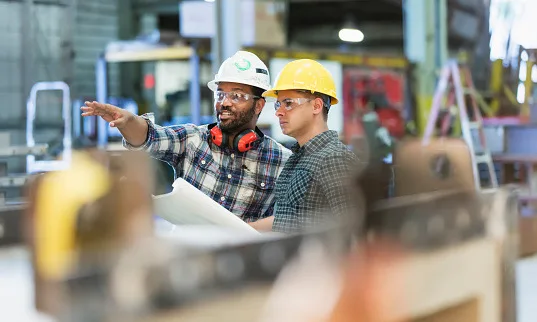
What is Short Interval Management (SIM)?
Short interval management (SIM) is a key Lean Management tool. Its objectives are to share common goals by defining indicators that make dysfunctions and time losses caused by certain processes visible.
SIM relies on visual management to track performance indicators (KPIs) and drive site performance. These visual elements enable real-time identification of performance gaps, allowing teams to respond quickly when problems arise.
What are the Stages of SIM?
The SIM process involves repeating short cycles of identifying and implementing effective actions to improve performance. Each cycle comprises 4 stages: the first 2 review the cycle just completed, and the last 2 prepare for the next cycle:
- Review the losses from the previous cycle and implement effective actions to address them,
- Review the actions taken in the previous cycle to assess their effectiveness,
- Identify risks associated with changes that could have a negative impact,
- Decide on actions to implement to improve performance.
SIM therefore combines historical analysis of overall performance and actions taken, identification of future risks, and the planning of positive-impact actions.
SIM is built around very short meetings held on production sites with a limited number of participants. These meetings serve to identify short-term problems and rapidly activate solutions.
These meetings, which typically last no more than 10 minutes, are structured in 3 phases:
- Identify previously encountered problems and find potential solutions,
- Identify changes that may occur in production and find solutions to prevent them from negatively impacting performance,
- Prioritise actions by ranking them in order of importance and impact.
For these meetings to be as effective as possible, it is important to involve a focused team of 3 or 4 people who are empowered to take direct action on the manufacturing process.
If a more significant problem is identified during these short meetings, it should be escalated to management and addressed in a dedicated meeting, without encroaching on the SIM process.
What are the Benefits of SIM?
SIM offers numerous benefits: as noted above, it enables real-time visibility of information so that teams can respond quickly when problems arise. It also:
- Restores autonomy to employees,
- Aligns objectives across multiple levels of the production site,
- Prevents managers from becoming overwhelmed, facilitating decision-making.
Thanks to these many advantages, the tool has genuinely taken hold across industries and has further improved with the emergence of new digital tools.
The Rise of Digital SIM
Like many Lean Management tools in industry, SIM now leverages new technologies to improve its effectiveness. The digitisation of physical supports through specialised software has enabled better information sharing between stakeholders, real-time visibility of performance indicators, greater agility in meeting customer requirements, and an increase in the site's collective intelligence.
The rise of digital SIM fosters a culture of continuous improvement and operational excellence. Moreover, it is a participative management approach that enables employees to gain greater autonomy.
How to Implement SIM?
Roadmaps exist to facilitate the SIM implementation process. The key steps include identifying a pilot area, defining relevant performance indicators for the production site in question, verifying data accuracy and quality, and creating a tracking tool.
Furthermore, when implementing SIM, it has become essential to integrate operational technology to improve performance significantly.
Read next
ZOZIO viewpoint
[ Interview 4.0 ] George Elias, Zozio : « Most ERPs aren’t enough to manage intermediate status »
George Elias is Technical Sales Manager for France and Sales Manager North America dedicated to Zozio’s development in the United States. We intervie…
ZOZIO viewpoint
MRO Scheduling: why static scheduling tanks your TAT
It's not variability that degrades TAT — it's the tool that pretends variability doesn't exist.
Expert guide
How has digital technology transformed the work of operators on the factory floor?
Digital technology: real added value on the factory floor Through new technologies such as augmented reality , artificial intelligence , and the digi…