

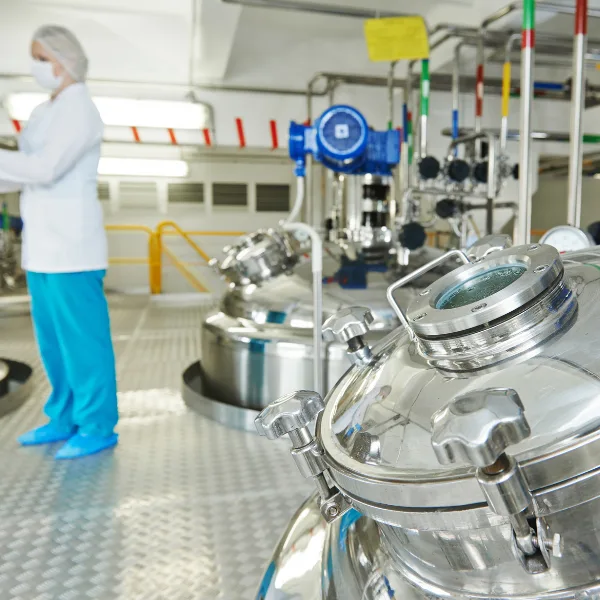
Challenge no. 1: Production scheduling
To plan production with all the necessary information to hand, several prerequisites are required:
- Having excellent visibility into the progress of the various manufacturing stages,
- Knowing the location of containers, their availability, and the immobilisation rate of vats in the vat fleet,
- Knowing the real-time status of containers (wash cycle in progress, disinfection, etc.),
- Knowing the expiry status of raw materials,
- Being able to track the exact location of containers when in transit with subcontractors
By accessing this information, it becomes possible to prioritise the use of containers and their contents (FIFO / LIFO management with last production/modification dates, expiry durations, zone management, etc.).
You know at all times exactly which vats are available for production (those under maintenance, those awaiting return from subcontractors, those immobilised, those that are clean, being washed, or already washed).
Challenge no. 2: Production optimisation
To optimise production, vat search time must be kept short, and it must be easy to check their status (condition, contents, storage zone, etc.).
When vat search and status are not digitalised on a platform accessible to the shop floor — a real-time collaborative platform — manufacturing teams waste valuable time.
How do manufacturing teams benefit from process digitalisation?
- They can access data quickly and manage the various wash cycles just-in-time, ensuring no clean vat sits idle without a production run for too long. This also avoids unnecessary container repurchase caused by inventory errors in the vat fleet.
- Automation simplifies the management of residuals. It is therefore possible to know when a residual has not changed status for a long time.
- Automatic alerts for expiry statuses allow potential issues to be anticipated. Operations teams can then adjust the schedule as needed to bring raw materials with approaching expiry dates into production.
The ROI of this type of action is immediate: less waste, higher quality, and fewer line stoppages.
Process analysis automation, powered by the ROBIN software developed by Zozio, delivers complex insights made accessible and easy to consult at a glance — such as the average shelf life of a liquid in a vat, or the waiting time within a zone and between two zones at each manufacturing stage.
Automated stock takes and access to asset distribution by zone prevent outright production losses and ensure there are always sufficient containers available.
The various levels of data analysis and their visualisation within the ROBIN platform make it possible to improve the turnover rate of containers and their contents at specific process stages or at subcontractors.
Production levels can be managed by workstation, with minimum and maximum thresholds defined to trigger an alert system if they are breached.
Challenge no. 3: Regulation and quality
When it comes to regulation and quality, the key issue is traceability. This is particularly important in industries such as cosmetics, which involve perishable and costly materials.
- Conducting an objective, automated audit of flows taking into account several years of production history,
- Centralising traceability data including the evolution of asset characteristics and the management of ADR certificates.
Challenge no. 4: Operational excellence in production
To deliver operational excellence, Zozio offers manufacturers several solutions — both physical and digital — through its ROBIN platform:
- Creating exclusion zones for specific containers and alerting in real time across different media (SMS, emails, notifications, “physical” alert with rotating beacon).
E.g.: alerting to the presence of a full vat in a washing zone, or to the presence of an incompatible product next to another.
- Ensuring operational quality and confidence in production operations through real-time flow visualisation for all relevant business teams.
Challenge no. 5: Managing a container fleet
How can a container fleet and its management be optimised?
- Having excellent visibility into container utilisation rates. By visualising better, you can produce more with less.
- Estimating the number of available vats using machine learning over the coming minutes, hours, and days, in order to anticipate their usage.
Challenge no. 6: Maintenance
Effective maintenance management has several positive impacts:
- Managing EHS and ADR statuses: it is possible to know that a vat displaying a given status is unavailable for production and to receive a preventive alert before any new maintenance task. This reduces the time the vat is held in that state.
- Optimising the execution of maintenance operations (sequential or pooled).
- Knowing which vat has not been used because it could not be located (at a subcontractor, in transit, etc.).
- Alerting to and anticipating the date of the next maintenance task.
This involves being able to quickly display the full traceability of a vat's past events and its defining fields, and to easily tally specific operations carried out on the vat.
Challenge no. 7: Traceability
Among the issues frequently encountered by cosmetics manufacturers, vat traceability — when not optimised — creates several problems, particularly during the transit of vats outside the facility and in identifying which vats are affected. It becomes impossible to remove a vat from the system to update its availability.
The ROBIN software thus enables:
- Automatically alerting a subcontractor of the maximum deadline for the return of a vat (the delay configured between the moment the container leaves the site and when it must be back in the vat fleet).
- Knowing the financial impact of losing a vat and its contents by assessing its unit cost and the rental cost of unused vats, while monitoring poorly optimised return processes.
- Automatically managing the progression of vat statuses according to the geolocated zone corresponding to a process stage.
- Managing vat-pooling operations between logistics and production.
- Ensuring digital tracking of work orders (WOs) and data backup.
- Conducting automatic stock takes of WIP (work in progress) and semi-finished products linked directly to the physical flow of containers, rather than IT movements that may show discrepancies with shop-floor reality.
For the resolution of these use cases to be successful, the ergonomics of the solution used matter — in particular the ergonomic display of:
- Production data,
- Available containers,
- The traceability of containers in transit both within and outside the facility.
Data centralisation is key. Searching for information in a poorly designed ERP is a waste of time. Display ergonomics has immediate intrinsic value.
That is why Zozio offers production experts an easy-to-use application, available at the line side on any type of screen (connected touchscreen, computer, smartphone, tablet…).
Read next

Expert guide
What is Lean Six Sigma?
What are the principles of Lean Six Sigma? As its name suggests, Lean Six Sigma is the combination of two continuous improvement methods: the Six Sig…
Expert guide
How can working conditions for employees in industry be improved?
The importance of improving working conditions in industry Improving working conditions for employees is one of the key concerns in industry and form…
Expert guide
Reindustrialisation: Where Does France Stand?
To remain competitive on the international stage and ensure its economic sovereignty and independence — particularly in times of crisis — France has…