

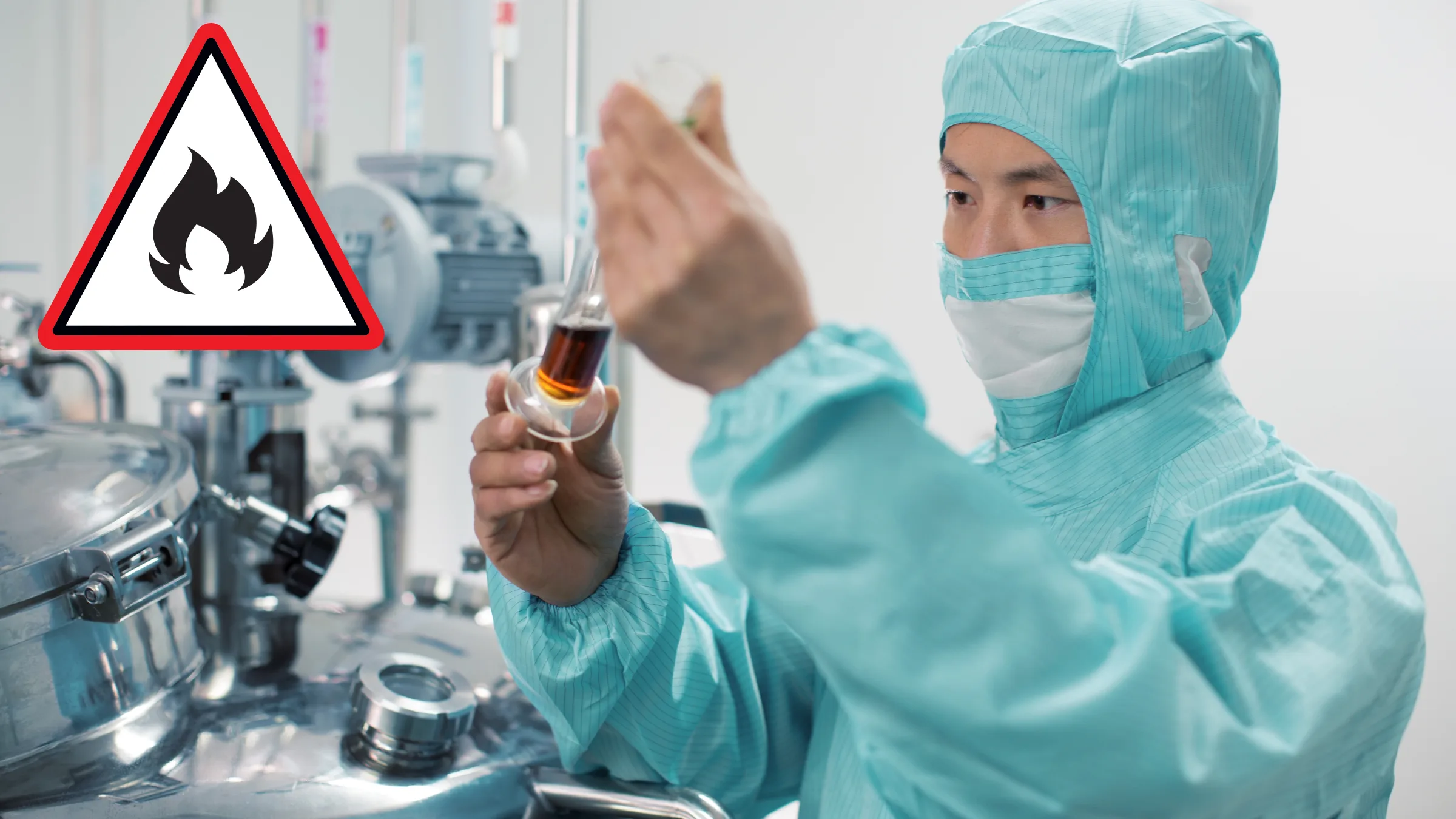
The pharmaceutical and cosmetic industry, due to the large quantity of chemical products stored and used in the laboratory and in the production area , involves many risks that it knows how to control by following the standards. For explosion risks, the European ATEX directive provides for all the steps required for the perfect management of flammable substances in order to reduce the probability to a minimum.
The ATEX standard for combustible materials and explosive products
Definition of the ATEX regulation (European directive)
The ATEX regulation (for “Explosive Atmospheres”) is the result of two European directives:
– Directive 1999/92/EC of 16 December 1999 for the protection of workers, transposed into the Labor Code,
– Directive 2014/34/EU of 26 February 2014 on equipment and protective systems intended for use in potentially explosive atmospheres, transposed into the Environment Code
As a result, it defines all the requirements for the safety of employees working in areas at risk of explosion , regardless of the size of the company. Thus, all organizations that may use hazardous materials or flammable substances are obliged to follow this regulation.
The pharmaceutical and cosmetics industry is directly concerned
Among them, the pharmaceutical industry (IP) and the cosmetic industry, also called “pharma & cosmé”, whose materials and chemicals (solvents, acids, perfumes, etc.) carry risks of fire or explosion if not stored or handled correctly.
The presence of a gas, a spark or a poorly extinguished cigarette, or more generally a high temperature , is enough to cause an accident.
Production machines also carry risks, which is why extreme vigilance must be exercised at all times, both by those responsible for safety and by managers and employees. This is for the safety of everyone inside and in the direct vicinity of production areas and premises, but also outside if the explosion leads to the emission of toxic fumes.
The 7 steps of the ATEX standard for the pharmaceutical and cosmetic industry
First of all, it is interesting to note that the ATEX standard follows the same path of preventive action and monitoring as the HACCP standard in food hygiene. This is also the case in other areas that rely on continuous improvement and lean management. In all cases, it is a matter of anticipating all situations that could “go wrong” , so that we can react early enough and, above all, prevent a tragedy from occurring in the production area. Then, in a second step, to improve the monitoring processes continuously.
To implement preventive actions in compliance with the ATEX standard in your industry pharmaceutical or cosmetic, here are the 7 steps to follow scrupulously :
1 – Identify the areas at risk of explosion in your facility (this concerns both areas where chemicals are handled and those where they are stored),
2 – Evaluate the explosion risks associated with these areas, taking into account the materials and chemicals used, as well as the operational conditions: these are both the acute and immediate risks of explosion, but also the chronic risks which, little by little, can lead to an accident. It is also necessary to determine, in the event that this should happen, what the power of the explosion would be.
3 – Check the adequacy of the equipment and protection systems in relation to the ATEX standard for these explosion risk areas,
4 – Implement safety procedures for the proper handling of materials and chemicals , as well as for the use of protective equipment in accordance with the ATEX standard,
5 – Train your employees in the handling and use of materials and chemicals, as well as in the use of protective equipment. To do this, you can call on a certified training company with ATEX accreditation, and set aside a dedicated time for each new hire, for example,
6 – Carry out regular inspections of your premises to check that your installations and organization are still compliant with the ATEX standard, and that the processes are respected by your employees,
7 – Design a safety management system, from storage to handling , to analyze and continuously improve your risk reduction efforts.
The issue of explosive storage
Receiving hazardous materials and explosives is already an important step. But storage and logistics in the pharmaceutical and cosmetics industry present particular risks that must be taken into consideration within the ATEX regulations, particularly with regard to zoning of points of vigilance.
In particular, you must arrange your storage areas in such a way that incompatible explosive products are not located close to each other.
In the same way, be sure to organize your stocks so that packaging and other cartons are not at risk of breakage, and consequently of leakage, and are then at the mercy of dangerous reactions. Also note that damaged packaging can cause raw materials to change and become explosive.
Among the processes to follow in the storage of your hazardous raw materials, here are some tips:
– Use metal shelving (for its resistance) – Check the stacking and height processes to avoid bad encounters with hazardous materials – The ventilation of the room must be mechanical , the stored products must be protected from humidity and heat – Be uncompromising on the maintenance of the storage area to avoid the accumulation of dust and other molecules that could be incompatible with your products – Store in such a way as to have the least amount of hazardous materials present at the same time
As a highly risky field, the pharmaceutical and cosmetic industry must adapt its entire organization to the ATEX regulations in order to avoid explosions and thus protect its employees as well as its reputation.
Read next

Expert guide
What are the differences between a TMS and a WMS?
In this article, we will define what a TMS and a WMS are, and we will establish the advantages and differences that exist between these two systems.…

Expert guide
Challenges of scheduling in aviation MRO
Regulatory Compliance and Financial Performance: The Strategic Edge FAA Regulatory Alignment and Part 145 Compliance In the United States, maintainin…

Expert guide
How can working conditions for employees in industry be improved?
The importance of improving working conditions in industry Improving working conditions for employees is one of the key concerns in industry and form…