

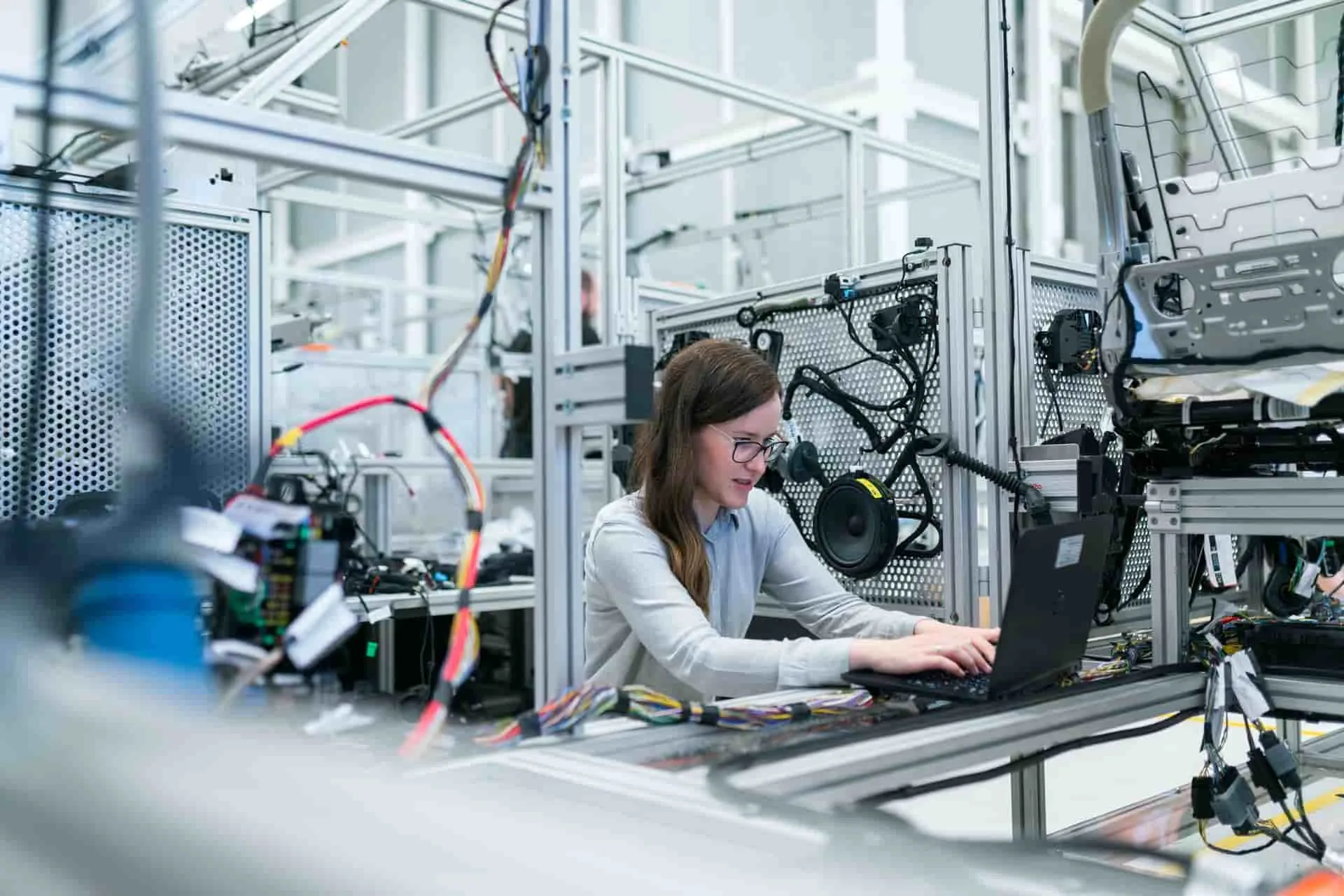
To boost productivity, many industries now use production management software. As continuous improvement tools, these systems have a significant impact on every aspect of production — from procurement to the final product, including execution issues.
The two most widely used types of software are ERP and MES. In this article, we examine the key differences between these two tools and the situations in which each is used.
First, what is ERP? ERP, which stands for Enterprise Resource Planning, is a type of software used in production units to manage resources.
In practice, ERP enables:
- Specifying the type and quantity of material required to fulfil an order,
- Indicating the lead times to allow for an order, based on overstock levels and supplier flexibility,
- Collecting production data.
All information in the ERP comes from data entered by employees or from other software deployed by the business. ERP usage is therefore organisational in nature, driven by support functions and the production manager.
The MES (Manufacturing Execution System) is software that enables production monitoring. It is often described as the "conductor" of a factory.
This software is therefore used to organise all industrial production. In practice, MES can:
- Automate production orchestration through AI-driven process control,
- Optimise maintenance protocols with intelligent monitoring and predictive maintenance solutions,
- Connect the supply chain to the shop floor through automated order downloading and execution.
MES thus acts as the link between factory operators and the supply chain.
What Are the Differences Between ERP and MES?
ERP and MES differ on one fundamental dimension: time scale. Whilst ERP operates in hours, MES works at the level of minutes or even seconds. As a result, ERP lacks the granularity to collect and process data in real time.
ERP therefore displays and consolidates information from the shop floor, focusing on production management at a daily or weekly level. MES, on the other hand, delivers the right information to the right person at the right time, in real time: data collection, KPIs, and execution support.
The two types of software differ in other ways too, such as the level of information detail. Because they address different needs, they offer different levels of granularity.
The Complementarity of Solutions
The differences between ERP and MES make them complementary solutions for exchanging, exploiting, and consolidating a company's production data. Through mutual data sharing, MES can, for example, manage the production schedule and work instructions by retrieving relevant information from the ERP.
SCADA: The Third Software Layer for Operations Management
In addition to ERP and MES, there is a third type of software: SCADA. SCADA (Supervisory Control and Data Acquisition) is a category of software encompassing numerical control and automated machine management solutions.
SCADA software acts as a direct interface with the machine. By analysing data directly from sensors, it enables direct intervention in the programming of production machines by modifying certain parameters.
By combining these three software layers, a company can manage its production more effectively within a continuous improvement approach, thereby driving greater productivity.
Read next

Expert guide
How has digital technology transformed the work of operators on the factory floor?
Digital technology: real added value on the factory floor Through new technologies such as augmented reality , artificial intelligence , and the digi…
Interview
Cédéric Berg’s winning strategy as Plant Manager at Vetrotech Saint-Gobain
Development - Digitalisation - Reliability: a plant manager’s winning strategy For the past five years, Cédéric Berg has been at the head of one of t…

Event
Hannover Messe 2023: Looking Back on a Successful Debut for Zozio
A Guided Tour of Hannover Messe 2023 with Zozio Hannover Messe – or the Hanover Fair – is the world's leading gathering for international industry ex…