

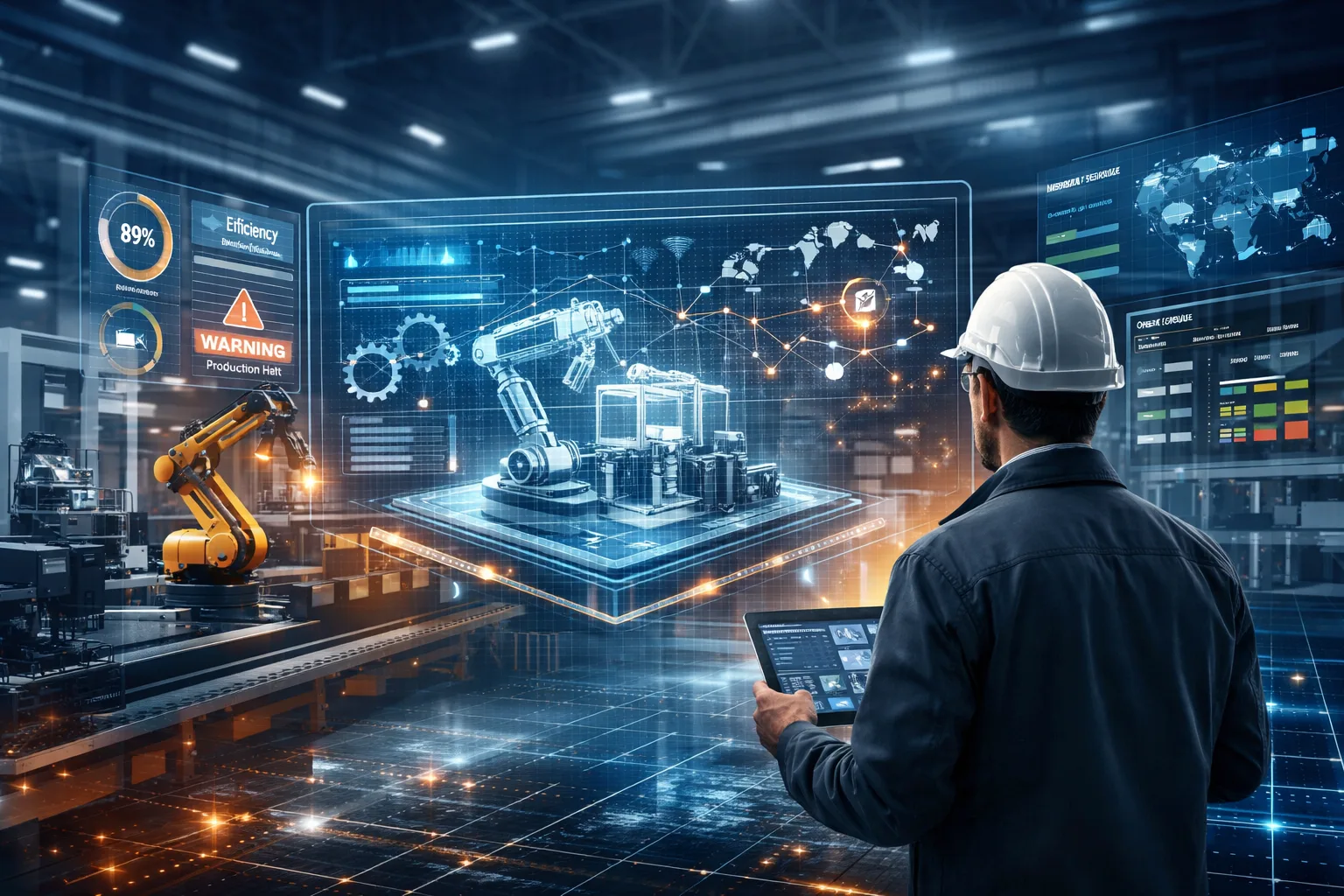
European industry facing an equation that has become structural
European industry is undergoing a structural break. Performance is no longer determined solely by nominal productivity, but by the ability to absorb the unexpected: breakdowns, supply chain disruptions, skills shortages, accelerating staff turnover, greater customer demands, and tightening regulatory constraints.
In this context, industrial companies already hold a major strategic asset: operational data. Instrumented machines, connected tooling, MES, CMMS, ERP systems, HR data, metrology, IoT sensors… The problem is not a lack of data, but its fragmentation, its lack of structure, and above all its failure to be activated in real time.
This is where the concept of an industrial data goldmine emerges — one that can only be exploited if the company equips itself with a real-time production digital twin, capable of faithfully representing physical, human, and logistical entities, and of orchestrating decisions in the face of disruptions.
The industrial data goldmine: strategic and operational definition
Talking about “industrial big data” is a dangerous oversimplification. Value does not lie in data volume, but in the ability to structure data around business objects, link them together, and exploit them in short decision loops.
The goldmine comprises:
- machine data (states, alarms, performance),
- tooling data (actual usage, metrology, maintenance),
- flow data (work orders, customer priorities, dependencies),
- human data (skills, availability, constraints),
- supply chain data (parts availability, lead times, risks).
Without a digital twin, these data sources remain isolated deposits. With a digital twin, they become a living system, capable of answering one key question:
“What is happening right now, and what must be done immediately to minimise the business impact?”
The real-time production digital twin: an industrial nervous system
A production digital twin is not a 3D visualisation or a simple dashboard. It is a dynamic, causal representation of the real industrial system, capable of integrating real-time events and calculating their impact across the entire value chain. It acts as an industrial nervous system, linking perception, analysis, and action.
In an industrial environment (MRO, for example), where variability is high and dependencies numerous, real time is a critical factor. Information received several hours late has often lost all its value. The digital twin maintains an accurate, continuously updated picture of production, enabling rapid, contextualised, and objective decision-making.
Machines and Maintenance: From Raw Data to Business Impact
Production machines are generally well-instrumented, but the data they generate is too often siloed in technical systems. The digital twin places this data back in its operational and economic context. A machine stoppage is no longer merely a technical event; it becomes a business event, as its impact on work orders, customer lead times and team workload is immediately visible.
By integrating maintenance histories, reliability indicators and actual usage data, the digital twin makes it possible to anticipate performance degradation and trigger actions before a failure occurs. This approach transforms maintenance from a reactive cost centre into a lever for industrial performance and operational continuity.
Real-Time Detection of Production Stoppages: From Alert to Orchestration
Real-time detection of production stoppages is often presented as an end in itself. In reality, it is merely a prerequisite. The real value is created when this detection is immediately linked to an orchestration engine capable of proposing appropriate responses.
Thanks to the digital twin, a stoppage is automatically correlated with the affected work orders, the tools concerned, the required skills and supply chain constraints. The system can then simulate different scenarios — such as rerouting production, partial rescheduling or the targeted triggering of a maintenance intervention. This ability to act quickly limits the domino effect of disruptions, which is particularly critical in MRO and high-variability environments.
Tooling and Metrology: Tapping an Often-Overlooked Goldmine
Tooling and metrology are among the most frequent blind spots in industrial performance. In many factories, maintenance and calibration decisions still rely on fixed schedules, regardless of actual usage. This approach generates either excess costs or non-conformity risks.
By integrating actual usage data, cycles, operating conditions and metrology results into the digital twin, it becomes possible to manage tooling dynamically. Drifts are detected earlier, interventions are planned at the optimal moment and non-conformities are prevented before they impact the customer. In MRO, this fine-grained control of tooling is a key factor in reducing critical asset downtime.
The Workforce: Structuring Human Data to Strengthen Resilience
The shortage of technical skills and rising staff turnover now represent major operational risks for European industry. Too often, skills are known informally, creating excessive dependency on certain key roles and weakening the organisation.
The digital twin makes it possible to structure human data operationally. Skills, qualifications, experience levels and availability are integrated into the same representation as machines and flows. When a disruption occurs, the system can immediately identify the human resources capable of intervening, taking into account regulatory and social constraints. This approach improves responsiveness, reduces pressure on experts and contributes to better talent retention.
Supply Chain Disruptions: Managing Uncertainty Rather Than Enduring It
Supply chain disruptions have become a structural phenomenon, no longer a cyclical one. Supplier delays, critical component shortages and geopolitical tensions have a direct impact on production and maintenance. Without an integrated view, these disruptions translate into delayed and often costly decisions.
The real-time production digital twin makes it possible to link supply chain events to field operations. When a component becomes unavailable, its impact on lines, work orders and customer commitments is immediately visible. The system can then simulate alternatives — such as prioritising certain orders, substituting components or adapting maintenance plans. This simulation capability transforms crisis management into rational decision-making.
The Waze Analogy: A Natural Fit for Modern Industrial Operations Management
Waze has profoundly transformed navigation by offering a real-time view of traffic, enriched by data contributed by users. What makes Waze powerful is not the map, but its ability to detect incidents, measure their impact and continuously recalculate routes.
The industrial digital twin works on the same principle. Machines, sensors, and operators act as Waze users, continuously feeding back real-time field data. The system aggregates this data, detects anomalies, and suggests alternative routes to meet production targets. Running a factory without a digital twin today is like driving without GPS in a congested, unpredictable environment.
Target architecture: technological sobriety and operational efficiency
The success of a digital twin project depends less on technological sophistication than on architectural coherence. Reliable real-time data ingestion, a unified object model, and a business-oriented orchestration layer are the key elements.
The goal is not to replace existing systems, but to connect them and restore their operational relevance.
The projects that succeed are those that start with concrete use cases offering a strong return on investment — such as reducing unplanned stoppages or optimising MRO interventions — before scaling progressively.
Measuring value: decision-oriented KPIs, not technology
The performance of a digital twin is not measured by the number of connected sensors, but by the improvement of operational decisions. Reducing mean time to restore service, improving OEE, lowering non-conformances, and making better use of critical skills are far more relevant indicators than purely technical metrics.
The digital twin as a new industrial competitive advantage
The manufacturers who succeed in volatile environments will be those who have turned their data goldmine into a real-time operations management system.
The production digital twin is not a technology trend, but a structural response to an industrial world that has become uncertain.
The data already exists. The difference now lies in the ability to orchestrate it.
Frequently asked questions about digital twins
- 01 What is meant by “data goldmine” in industry? It is the full set of structured, correlated data (machines, tooling, metrology, maintenance, staff) which, once modelled in a real-time digital twin, becomes actionable for anticipating and resolving disruptions.
- 02 What are the first use cases to implement? Real-time detection of stoppages + routing to a qualified technician, dynamic management of critical tooling and metrology alerts, WO rescheduling in the event of a component shortage.
- 03 What are the adoption risks? Poor data quality, organisational silos, uncontrolled technical complexity, and resistance to change; these are mitigated through MVP, governance, and co-design with frontline teams.
- 04 How does the digital twin help in the face of supply chain disruptions? It enables simulation of the impact of a supplier delay on lines, testing of alternative scenarios (substitution, rerouting), and prioritisation of actions based on customer criticality and parts availability.
Read next
Expert guide
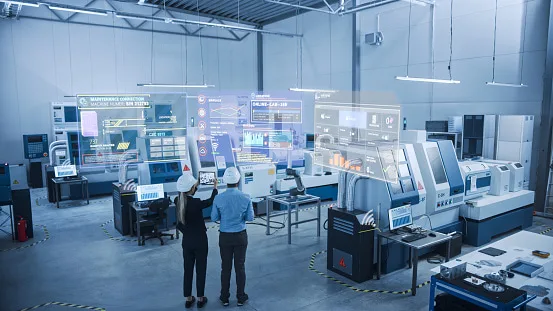
Digitalisation and Artificial Intelligence in the Service of Industry 4.0
The fourth industrial revolution, or Industry 4.0 , has been made possible by the digitalisation of businesses . Indeed, the shift from traditional m…

Expert guide
Challenges of scheduling in aviation MRO
Regulatory Compliance and Financial Performance: The Strategic Edge FAA Regulatory Alignment and Part 145 Compliance In the United States, maintainin…

ZOZIO viewpoint
MRO Scheduling: why static scheduling tanks your TAT
It's not variability that degrades TAT — it's the tool that pretends variability doesn't exist.