

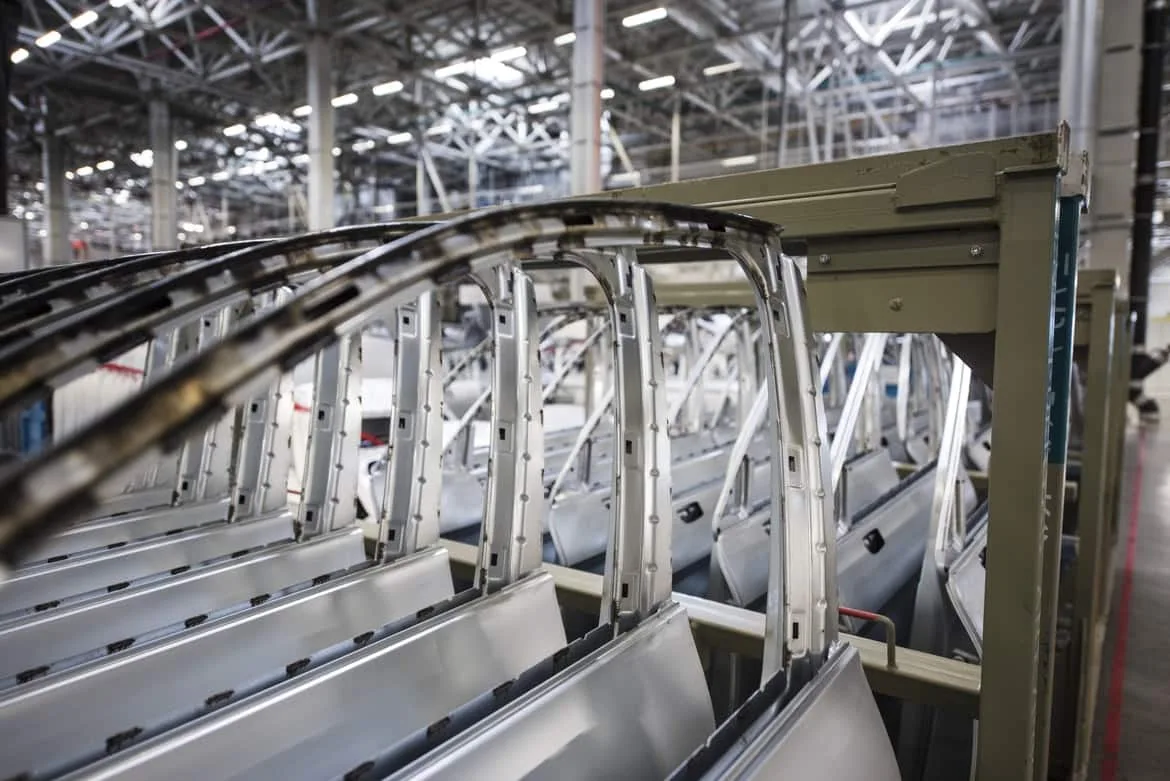
The Importance of Traceability in the Automotive Industry
In the automotive industry, it is essential to define standards for all elements entering the supply chain. Automotive parts, packaging, and pallets must be harmonised across the various automotive players to achieve optimal flow visibility.
It is from this need that Galia was born in 1984. The Groupement pour l'Amélioration des Liaisons dans l'Industrie Automobile is an association whose mission is to improve exchanges between partners in the automotive industry through the standardisation of product and information exchange methods.
Founded on the initiative of Renault and PSA Peugeot Citroën, the association is presided over alternately by a representative of Renault and Stellantis. It currently has 250 members, including industrial companies, professional organisations, and service firms.
Galia is active in the fields of logistics, engineering, B2B (Business to Business), and professional electronic data exchange.
Galia's Logistics Committee
To optimise traceability, Galia's logistics committee has established standards. Galia emphasises their contribution to the efficiency and performance of the companies that adopt them. Standardising identification facilitates international exchanges and enables interoperability between different partners.
Standardised means include returnable and expendable packaging, as well as identification labels.
In practice, representatives from various automotive manufacturers and Galia project managers meet four times a year to discuss logistics and traceability challenges and fulfil the objectives below:
- Meeting standards requirements,
- Supporting members in implementing the tools developed,
- Ensuring liaison between the various organisations.
Traceability at Galia
Galia offers a traceability service for elements circulating within production flows. These elements are identified and tracked, notably through EDI or EDTi — Electronic Data Interchange and Electronic Technical Data Interchange respectively. This involves the implementation of B2B exchange standards, carried out under the auspices of Galia's Logistics Committee.
An Example: The Galia Label
For example, the ETI9 label, or Galia label, is widely used in the automotive industry. It corresponds to the standardised labelling format for handling units and packaging units within the industry.
It displays the consignee, the sender, the net weight, the production date, and various barcodes to be scanned relating to the batch, the open order number, and so on.
Other types of labels also exist. In the automotive industry, RFID (Radio Frequency Identification) is frequently cited. This technology enables the characteristics of an item to be read remotely through identification and tracking. In practice, this is achieved via a radio-frequency tag comprising a chip connected to an antenna, which is read by a reader that transmits the information. Galia has recently made its implementation a priority.
Read next
Expert guide
What is a bottleneck and how can you limit its impact to optimise production?
What is a bottleneck? On a production line, a bottleneck is a workstation that receives more work than it can handle at its maximum production capaci…
Expert guide
Aeronautical MRO inventory management: how to avoid component shortages?
Why a 99% MRP Service Level Is Not Enough in Aerospace MRO In aerospace maintenance , logistics performance is often assessed using reassuring indica…
Expert guide
What Are the Differences Between a Digital Twin and a Unified Namespace?
Digital Twin and Unified Namespace: Understanding Their Real Role in Industry 4.0 Architecture In Industry 4.0 , the concepts of Digital Twin and Uni…