

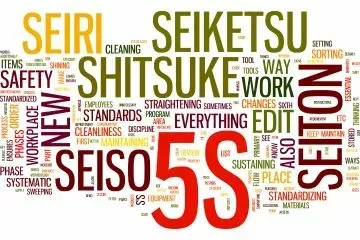
What Is the 5S Method?
As we briefly mentioned in our article "Lean Manufacturing: Discover the Essential Tools and Methods!", the 5S method is one of the cornerstones of Lean Management.
It continuously optimises working conditions by ensuring workstation organisation and reducing waste caused by disorder, unnecessary movement, and redundant or obsolete steps.
Indeed, working conditions are not always conducive to achieving peak performance — particularly when there is disorder or time is lost searching for the right tools.
Historical note: The 5S methodology originated in Japan and was created by Taiichi Ōno, the production chief at Toyota. Through this method, the company managed to return to success. Since then, the 5S methodology has attracted attention worldwide.
The 5S derive from the five operations that make up the methodology and stand for:
In this article, let us examine each of these 5 operations in detail.
The first operation is to sort. In other words, it involves organising work tools according to their frequency of use.
It may turn out that some tools are never used. This step therefore also involves eliminating the unnecessary. Rarely used tools can also be moved to a more suitable location.
The second operation consists of organising storage so as to minimise physical movement. This organisation is therefore preceded by the following questions:
- Which tool is used frequently, and by whom?
- Which tools must be accessible to everyone?
- How can access routes to the necessary resources be made as short as possible?
The storage system thus adopted must be made visible through a labelling system.
Seiso means to clean, or to repair. This applies to all equipment and tools. If any are broken or abnormally dirty, the causes must be identified so that the problem does not recur.
Even if this step is one of the most demanding, it is essential for improving the working environment, and with it, employee satisfaction.
This operation involves organising one's workstation so that all employees can navigate it easily, and standardising the way in which this organisation is carried out. It then becomes possible to plan which machines need to be cleaned and maintained, and at what frequency.
The final step consists of applying a continuous improvement approach. In other words, it involves adhering to the 4 preceding rules and sustaining them. For this reason, this last operation can be referred to as the “sustainment” of the method.
If any lapses occur during a cycle, it is important to address them in the following cycle, so as to improve the process on an ongoing basis.
What is the objective of the 5S methodology?
The primary objective of the 5S methodology is to improve company productivity by creating better working conditions for employees, who are thus encouraged to be more conscientious and accountable.
Implementing this method requires the participation of all employees. Working groups must be established, each with a responsible lead, to identify weaknesses in the supply chain and address them. The next step is to draw up a detailed action plan covering all the measures put forward by the various working groups.
What are the benefits of the 5S methodology?
The steps of the 5S method may appear straightforward and quick to implement. However, as we have just highlighted, for the method to work it is essential that all employees are actively engaged and make the necessary effort to carry it out correctly.
To that end, it can be useful for managers to remind staff of the method's many benefits. This helps motivate employees so that the method is implemented effectively.
The benefits of the 5S methodology include:
- An increase in employee wellbeing and satisfaction,
The 5S method benefits not only the company but all employees, who will work in a far more pleasant and secure environment.
- An increase in productivity,
Productivity rises naturally through the elimination of certain forms of waste, leading to an environment more conducive to work, well-maintained machinery, and tools positioned as close as possible to operators.
- An improvement in safety,
The organisation brought to the site helps reduce the risk of accidents by highlighting wear on infrastructure, machinery, or parts.
- A more pleasant working environment,
- Fewer material losses,
This reduction in material losses generates savings on resources.
- Freed-up space.
This opens up new possibilities for the areas that have been freed.
These benefits are by no means exhaustive, but they give a sense of the scope of the 5S method. Adopted more than 50 years ago in Toyota's factories, the method is an indispensable tool in Lean Manufacturing, supporting all companies in their pursuit of performance.
Read next

Expert guide
MES or ERP: What Are the Differences Between These Two Solutions?
To boost productivity, many industries now use production management software. As continuous improvement tools, these systems have a significant impa…
Expert guide
Factory of the Future: the Pharmaceutical Industry in Full Transformation
Digitalisation of Production, Regulation and Eco-Responsibility: Major Challenges and Multiple Imperatives for Pharma 4.0 The pharmaceutical industry…

Expert guide
What is a bottleneck and how can you limit its impact to optimise production?
What is a bottleneck? On a production line, a bottleneck is a workstation that receives more work than it can handle at its maximum production capaci…