

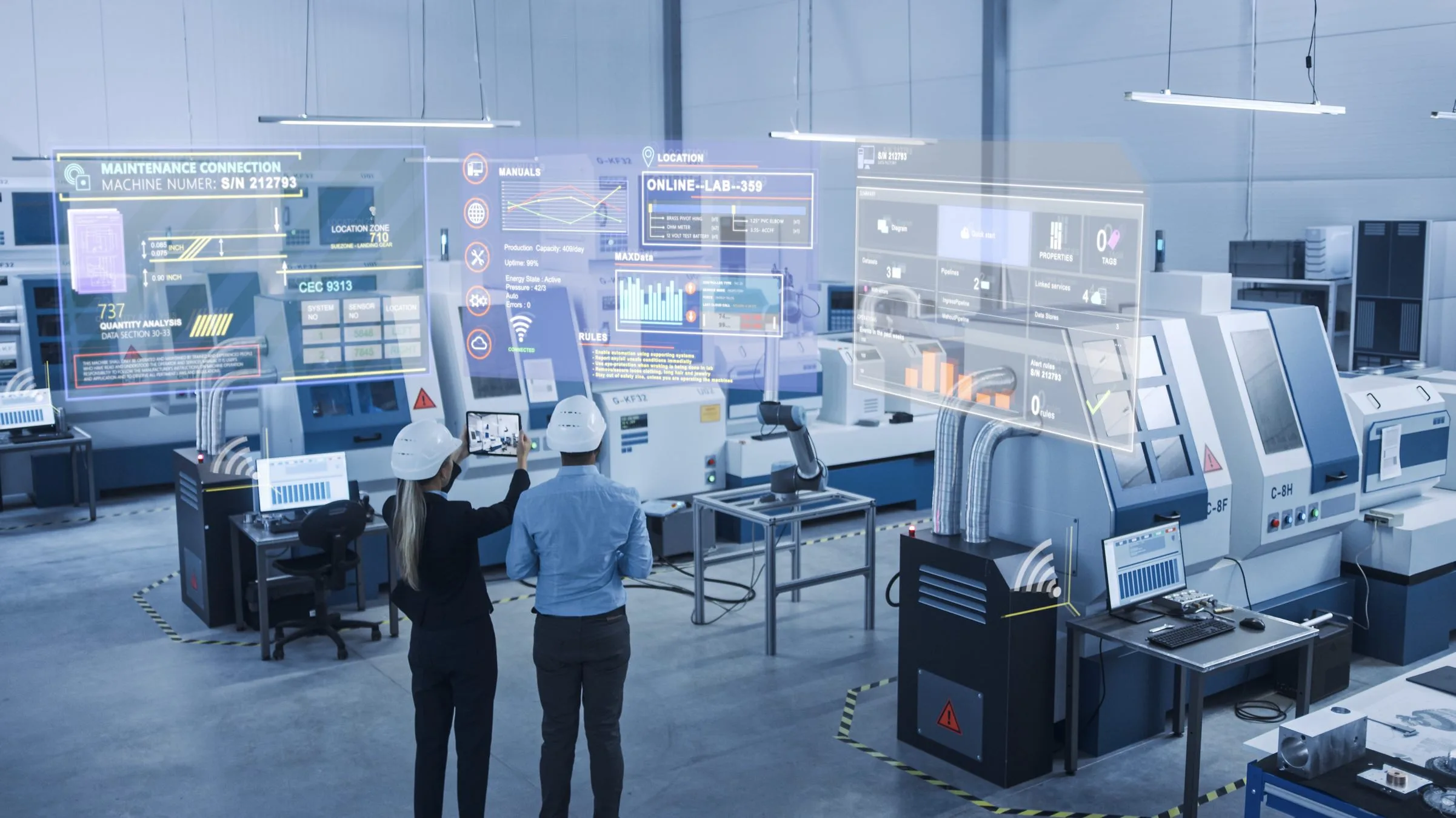
Does a factory work still have a place in this new version of industry, dominated by new technologies?
Digital transformation: definition
Digital transformation describes the changes implied by the implementation of new technologies in companies. This transformation affects, in addition to the fields of information and communication, the economic model of companies and the relationship to work.
Thus, in addition to technological evolutions, digital technology leads to behavioral and cultural evolutions.
With the emergence of connected factories , processes, activities and corporate culture have to be reinvented.
The emergence of a new industry: factory 4.0
The implementation of new technological tools in industries, such as augmented reality or robots for example, transforms no only manufacturing but also working conditions in factories.
As a result, employee training needs to evolve with these changes, in order to adapt skills to available resources.
As a result of the digital transformation of industries, the place of the human being has inevitably changed.
With artificial intelligence , machines now seem to do everything by themselves. Are we heading towards an industry without humans?
Factory employee and digital environment: a growing interaction
Studies show that artificial intelligence will not rule out the presence of humans in the work environment.
In fact, the factory worker is no longer the one who produces, but the one who manages the manufacturing process. His role is now to check, interpret, configurate and control the machines that produce for him.
In this way, the interaction between humans and technologies benefits from both the machine’s capacity to manage large databases and the human’s sensitivity, with its intuition, insights and analysis.
Cobotics: when humans and robots work together
This interaction between humans and robots optimizes the work of the factory employees, and is often referred to as augmented worker .
The robot is humain’s collaborator, not his replacement.
Modern robots can perform repetitive or potentially dangerous tasks instead of workers.
In fact, after the implementation of robots in factories, many companies notice a decrease in musculoskeletal disorders of their employees.
This collaboration allows workers to focus on more rewarding and motivating activities.
In other words, technology enhances human capabilities, not replaces them, in order to aim for continuous process improvement.
We must therefore rely on permanent innovation and collaborative work to be well anchored in the fourth industrial revolution , which is as much human as technological.
Read next
Expert guide
8 challenges faced daily by cosmetics manufacturers
Challenge no. 1: Production scheduling To plan production with all the necessary information to hand, several prerequisites are required: Having exce…
Interview
[ Interview 4.0 ] Harness the power of the digital twin to model an industrial environment
A digital twin is a virtual replica of a physical object. In most cases, digital twins used in industrial environments are innovation tools dedicated…
ZOZIO viewpoint
MRO Scheduling: why static scheduling tanks your TAT
It's not variability that degrades TAT — it's the tool that pretends variability doesn't exist.