

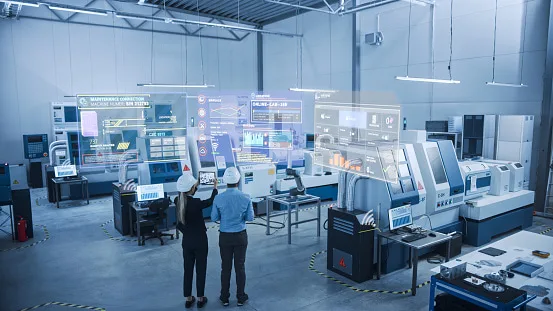
The fourth industrial revolution, or Industry 4.0, has been made possible by the digitalisation of businesses. Indeed, the shift from traditional methods to digital solutions has completely transformed the way businesses operate, introducing technology at every stage of production processes. Today, optimising processes through artificial intelligence is common practice across industries, enabling a marked improvement in overall performance.
Digitalisation and artificial intelligence: definitions
In this article, we explain the consequences of this digital transformation, as well as some of the digital tools that have become essential in business. But first, what is digitalisation?
Digitalisation is a process that aims to transform traditional processes through digital technologies in order to make them more efficient. For example, shops have been replaced by online stores, and trade shows by web forums. Its meaning is intrinsically linked to that of digitisation.
Digitalisation relies in particular on the IoT (Internet of Things), which makes it possible to monitor machines remotely and carry out predictive maintenance.
Artificial intelligence, for its part, involves implementing technologies that enable machines to exhibit a form of genuine intelligence.
Digital transformation: an essential step for businesses
Digitalisation and AI have revolutionised industry by making the digital transformation of businesses possible. This digital transformation is now essential to remain competitive and to achieve significant growth.
Indeed, it eliminates spatial and temporal barriers, enabling communication at any time with all colleagues, even those based in other countries. It then becomes possible to communicate with your entire team as if you were all working in the same space — even when travelling — thanks to mobile connectivity.
How to digitalise your business?
To digitalise your business, you need to leverage the digital tools available — such as websites, mobile applications, business software, and newsletters — to digitalise every aspect of the company and its management.
Depending on the nature of your industry, it may be relevant to implement the following tools:
- Visual identification: visual identification tools are very useful for quickly accessing the technical data sheet of identified equipment. In this case, AI enables better stock management, facilitating rapid ordering of the required parts and easy access to maintenance procedures.
- Connected objects: these dramatically improve the daily working lives of a company's employees. Among the most widely deployed connected objects, we find:
- Markers and probes: useful for checking, for example, the freshness of perishable goods or the fill level of a skip. Bluetooth labels: very useful within warehouses, they enable equipment to be geolocated.
To integrate digital transformation within industry, it is also essential to embed a digital culture within teams and practise change management, so that all employees are engaged in Industry 4.0.
Industry and the environment: digitalisation in the service of a greener business
One of the main objectives of our century is the decarbonisation of industries. Digitalisation and artificial intelligence are very promising tools for achieving this goal. Indeed, certain digital tools can reduce energy consumption or enable a reduction in material requirements, thereby helping to cut waste.
Among these tools, we find for example:
- Digital simulation: this enables the upfront assessment of the energy requirements of different factory processes, identifying potential losses and thus optimising consumption.
- Measurement sensors: thanks to the data they collect, it is possible to visualise precisely, and over time, the consumption and emissions associated with the various workstations on the production line. This ultimately enables better energy management of the most energy-intensive workstations.
- Predictive maintenance tools: these predict system failures before they occur, enabling better maintenance of equipment, which consequently lasts longer.
- Business Intelligence software: this enables better resource management, thereby contributing to waste reduction and the recycling of materials.
As these tools deliver greater reactivity and increased flexibility whilst reducing production and delivery lead times, industrial reshoring has also been a topic of discussion in France for several years. Indeed, the advantages of relocating businesses to countries with cheaper labour have been called into question since the emergence of Industry 4.0 factories. This reshoring contributes to the decarbonisation of industries by favouring shorter supply chains.
Read next
Expert guide
What is a bottleneck and how can you limit its impact to optimise production?
What is a bottleneck? On a production line, a bottleneck is a workstation that receives more work than it can handle at its maximum production capaci…

Expert guide
The ATEX standard in the cosmetics and pharmaceutics industry
The pharmaceutical and cosmetic industry, due to the large quantity of chemical products stored and used in the laboratory and in the production area…
Expert guide
The 21st-century industrial challenge: how to achieve carbon neutrality?
Industry accounts for approximately 18% of greenhouse gas emissions worldwide, just behind electricity and heat generation, transport, and agricultur…