

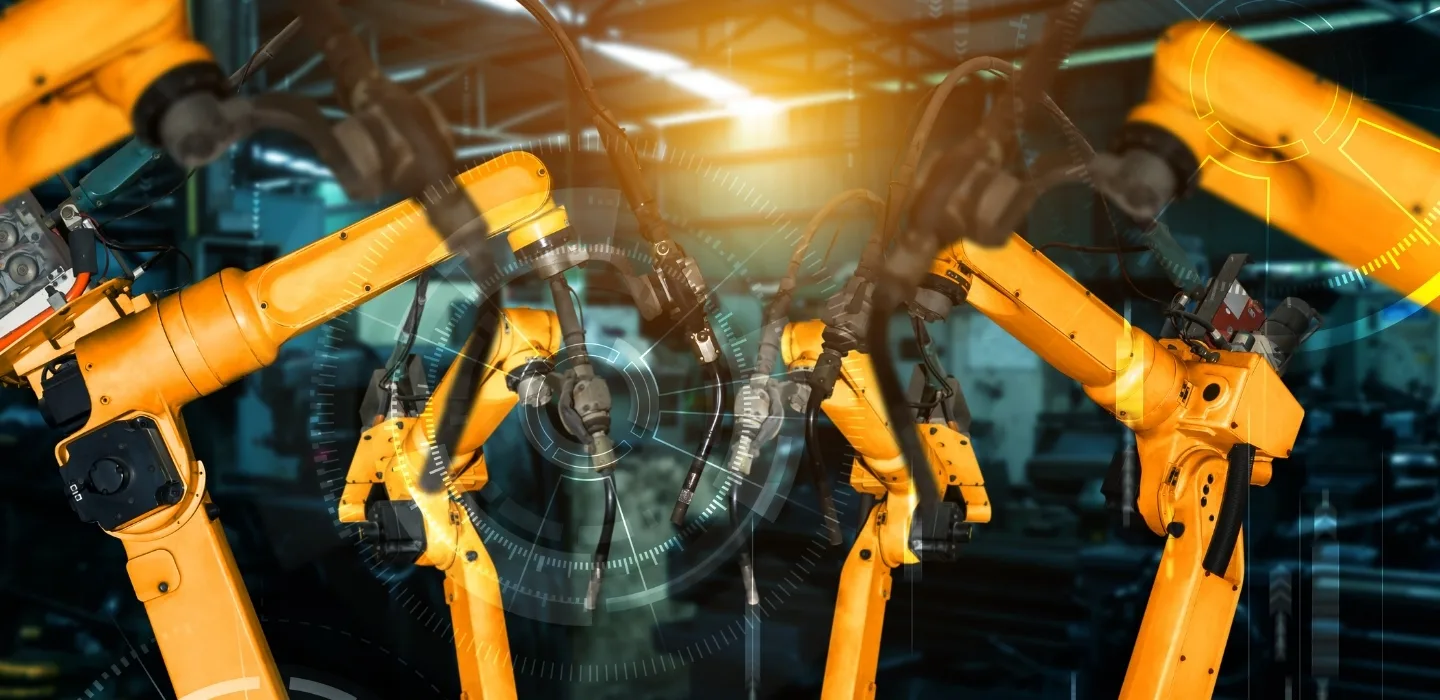
Let’s now look at the challenges of setting up “smart” factories.
The industry sector is evolving very rapidly over the years. Today, machines, products and people can communicate in real time.
All aspects of a product’s production can be tracked instantly. Many industries will have to adapt to this change regardless of the size of their industry.
Each company must be able to keep up with its competitors if it wants to stay in the market.
First, the change concerns the techniques used to manufacture products. Industry 4.0 combines several technological breakthroughs. Additive manufacturing, augmented reality, robotics, etc… will have to be implemented more or less directly in the manufacturing cycle of products.
We have already detailed in previous articles the technologies that will revolutionize our industry.
Industry 4.0 is also a cultural issue. We see more and more the creation of collectives gathering companies, research centers, universities and customers. This is a major advance because it breaks the traditional codes.
A single company will not be able to enter the fourth industrial revolution in the years to come without collaborating with key partners.
Change management has never been so important. The new ways of working will force employees to question themselves. Unfortunately, these changes are not accepted.
Culturally, the implementation of robotic solutions means job cuts. Japanese and German examples show us that the most industrialized countries have very low unemployment rates.
By choosing to anchor your company in the factory of the future, you can expect to experience a change in human resources.
Indeed, this choice implies a shortage of competent resources in the field of information technology, multi-dimensional design, exploitation of usage data and production.
These needs are directly linked to the technological challenges. There is a pronounced mismatch between training and the needs of the industrial fabric. A great deal of work needs to be done on training offers to bring them into line.
There are many challenges, but the investments required for this transformation are colossal. Thus, the question arises as to the concrete gains for a company to enter this 4th industrial revolution?
Companies expect these investments to increase their competitiveness and productivity. These gains are sometimes not directly observable.
The interconnection of all the actors in a global system allows productivity gains. Robots make the work of employees easier and more efficient . Moreover, since the resources needed by industry are not unlimited, they must be optimized.
For this, it is essential to have a global vision of the company and the machines.
The industry of the future allows the optimization of energy and raw material consumption .
This fourth revolution contributes to agile production: the units of the future, fully automated and interconnected, will be able to modulate production quantities instantaneously according to orders.
Today’s information technology tools and communication networks allow us to strengthen links with our customers through the information we collect, in real time.
Read next
Expert guide
How has digital technology transformed the work of operators on the factory floor?
Digital technology: real added value on the factory floor Through new technologies such as augmented reality , artificial intelligence , and the digi…

Expert guide
What is Lean Six Sigma?
What are the principles of Lean Six Sigma? As its name suggests, Lean Six Sigma is the combination of two continuous improvement methods: the Six Sig…

Expert guide
Industrial Automation: What Are the Challenges for the Cosmetics Industry?
How the cosmetics industry, a complex and highly regulated industry, is moving towards process simplification to optimise its production performance.…